25.5.07

As Stubborn as a Donkey

We've all heard this expression, I'm sure. In Niger we see donkeys everywhere, and they are some of the most difficult animals to work with. Yet, they get a lot of work done. Most of the carts that carry stuff around Tera are pulled by donkeys. Currently, we're having a lot of our water hauled in by donkey cart since we don't have any water coming into our pipes.


The classic stubbornness of donkeys is most revealing when you're traveling. If they're standing in the road, they won't move out of the way even if you're honking at them or racing up on them fast. At twilight, the gray donkeys are particularly hard to see because they blend in with the road and the sky. You have to keep a sharp eye out for them on the road because they won't move out of the way.

This stubbornness was illustrated in a hilarious way one day as we waited to catch the ferry across the Niger River. About 150 donkeys had come across the river on the ferry to our side, and the herders were trying to get them off the ferry so the cars could get on. There was a small gap of no more than three inches between the deck of the ferry and the ramp of the ferry. The donkeys refused to step over this gap. They would rather stay on the deck of the ferry where there was no food or water than step over the gap and move on to the "greener" pastures below. The herders were doing everything they could to get the donkeys to move: beating their backs with sticks, pulling their legs (literally), pushing them, and grabbing them by the nose and ears. The donkeys refused to budge. Or if they did, they would come up to the crack and circle back around onto the ferry deck. It was funny watching the whole incident.


Then it occurred to me that we can be a lot like those donkeys. We're comfortable where we are, thank you, and we don't want to move out of our comfort zone. God wants to lead us on to greener pastures and take us beside still waters, but we refuse. We'd rather settle for the slim pickings this earth has to give us than to step over the gap in faith into His arms and let Him lead us on. Sometimes God has to bring suffering or pain into our lives to get us moving and push us to step over the small crack we're afraid of. Or we're just happy to rely on all the things we possess and don't want to make a small leap of faith to trust God. God then gives us a good whack or pulls our legs, and we have to make that step of faith in pain. We question why God is doing this to us. If only we'd step over without complaining and knowing He is with us, we'd have a much more pleasant life.


Well, it took a half hour for the herders to get all those donkeys off the ferry, but they finally did, and what they left behind was their smelly detritus. I won't explain it to you, but you get the picture. It was awful. And the cars in front of us couldn't wait for the ferry workers to clean up the mess and sweep it off the ferry. We had to hold our noses when we got on and watch our step if we got out of the car. I'm not sure there was a spiritual application to that part of the journey, but I'll let you make an application if you can see one.
Maybe next time we should offer a carrot to the donkeys. NOT!! I don't think even that would have enticed them to step over the gap.

23.5.07

Thailand vs. Niger

Thailand is a truly and amazing and wonderful country. Nancy and I had the privilege of visiting there in March. Although I had lived in Asia (was born and lived the first four years of my life there), I had never before been in SE Asia. Nancy had never been in Asia at all. So it was quite an adventure for us.

We didn’t get to see a lot of Thailand while we were there because we were in meetings most of the time at a resort complex and we arrived and left at night, but what we saw gave us lots of room for comparison with Niger.

Of course, there are many differences. Niger is a land-locked country that is mostly desert while Thailand is situated on the ocean with a long coastline and abundant rain. Niger is on the shore of the Sahara, but we don’t have much water. Here is the view of the Gulf of Thailand that we could see every morning from the balcony of our 12th story room.

There are other differences as well. While the roads in Niger are very good for West Africa, the roads in Thailand are startlingly good. We were amazed to see so many traffic lights. And some of the lights had timers on them that digitally counted down the seconds until the light would turn red or green. In Niger we have very few traffic lights, and many of them don’t work all the time. Almost all the traffic lights are in the capital. You rarely see them outside of Niamey. In Thailand people drive on the left side of the road, and we had to constantly reverse the way we looked for traffic before crossing the road. Instead of looking first to the left, you have to look right. All of W. Africa (including Niger) drives on the right.

Another difference was the food. The staple crop of Niger is millet. Only three countries in the world have millet as the staple crop. The staple crop of Thailand is probably rice, but if I were judging by what we ate, I would say it was pineapples. About 30% of Thailand’s pineapples are exported to the United States, either in canned pineapple or as juice or in some other fashion. We can even get canned pineapple from Thailand in Niger!!! We had fresh pineapple on the table at every meal, and it was delicious and melt-in-you-mouth sweet. I am a fruit freak, and I had pineapple every single meal. There were also a variety of other fruits available, especially watermelon, banana and papaya. All these fruits we can get in Niger, but there also were some fruits that we had never seen. My two favorites were the dragon fruit, a pink pineapple-looking fruit that has white flesh with lots of little black seeds, and the rose apple, a light red, pear-shaped fruit that was crispy like an apple but was lightly sweet like an apricot. Then there was Thai food. Every night we had a choice between traditional Thai food and more western-style food. Nancy always went for the Thai food which was spicy and often had noodles with fish or Thai dumplings. It was all delicious. Our last night, we got to eat at a roadside café and really enjoyed the cuisine.

We saw very little poverty in Thailand, at least not like we see in Niger. Of course, we were in the tourist areas and Bangkok and did not get up into the countryside, and we did see some very simple dwellings (see photo), but the poverty seemed to be on a much more limited scale than we would see in Niger’s capital. Thailand looked like an economic boom town to us. That has its down side, and you are probably aware of the terrible traffic in which many in Thailand are engaged, but there were nice supermarkets, malls, several-story shops, etc. They even had Starbucks!! That’s something you don’t see in Niger. We had never been to a Starbucks before. Thailand was our first experience in a Starbucks.

The buildings in Thailand were also very different. There were lots of high-rise buildings, especially tourist hotels near the beaches, something we don’t have too much of in Niger. There were more humble dwellings, and as in Niger, there was very little wood used in construction, but many buildings were very fancy and modern-looking. Very few were made out of mud block, at least in the areas that we saw.

Another difference was, of course, the language and the religion. The language of Thailand, Thai, is spoken by about 60 million people and used all over the country, quite a contrast with Niger’s 20-odd languages, none of which is spoken by more than 10 million people in the country. Thailand is a Buddhist country, and we saw many Buddhist temples. Niger, of course, is a Muslim country. There were also huge statues of Buddha in the airport and many little shrines everywhere. We even saw a shrine outside a supermarket. The birds were eating the food offered at the shrine.

There were some surprising similarities between Niger and Thailand. The first, which wasn’t so surprising, I guess, is the weather. Both countries are, of course, in the tropics, so their weather patterns are similar, with alternating periods of dry and wet. Thailand was very humid, much like Niger is now in May. But it was nowhere near as hot as Niger in April and May. Another similarity is that Thailand was still in its dry season while we were there in March. (Niger’s dry season goes from October to May.) We were surprised at how dry everything looked. It wasn’t as brown as Niger, but the grass was often yellow, and trees looked a little limp and dry. We were told that it was the end of the dry season, and we did have one gully-wumper storm while we were there, but otherwise it was sunny and dry all day long.

Another similarity is the latitude of the country. If you look at a map, you’ll be surprised to find that Bangkok is at about 14º N latitude. That is the approximate latitude of Niamey, Niger. We thought Thailand was much farther south, towards the equator. Parts of it are, but only the long, skinny tail, down where the tsunami of 2004 hit.

There are also similarities in the transportation system. There are all kinds of cheap transport in Thailand, and vehicles often carry more people than they are supposed to. In Niger, 12-person vans called “bush taxis” are often loaded with as many as 24 people. They may also have loads on top which are taller than the taxi itself. In Thailand, they have modified pickup trucks (called “tuk-tuks” I think) with benches along the back and a step on the back for people to hang onto if the benches are full. We saw lots of people hanging onto these “tuk-tuks” and even got to ride them several times.

One of the most beautiful similarities between the two countries is the friendly people. Hospitality to strangers holds a very high place in both cultures. This is not true of the USA and most European countries, at least nowhere near at the same level. The Thai are a beautiful, hospitable people who try to make you feel at home and provide for your creature comforts. We were well cared for. Niger’s people are also very friendly and hospitable, and you can easily make friends with total strangers.

It was a great trip to Thailand, tiring with long layovers in airports (we got to visit Dubai airport for the first time and fly Emirates, one of the best airlines in the world), and we really enjoyed our visit to this wonderful country.

22.5.07

Toad Trivia

Here are several things I did not mention in my last blog on Téra’s toads.

You know the story about the prince that was turned into a toad by magic, and the only way to break the spell was for a princess to kiss the toad? Well, for all you princesses out there, I advise you not to kiss these toads. They are definitely not prince material and they do not live in Toad Hall.

A few weeks ago, Nancy attended the wedding of a neighbor. The women were all sitting around outside on mats in the darkness, and who should hop up to join the party but one of these wart-covered toads. One of the ladies attempted to pick up the toad to eject him from the party. You know what a toad does when you try to pick it up? Yeah, and this one let loose with all jets, and sprayed Nancy on the leg. Then, of course, there was a lot of fuss as the ladies tried to clean Nancy up and get all the sticky liquid off of her.

We’ve had a few rains in Téra recently (May 6 and May 13), and there’s been enough rain in the surrounding countryside to fill up the dry stream bed that flows not even a kilometer from our house. A few days after the first rain, we heard the bloated burping sound that many toads together make coming from the direction of the stream. We had not known the stream had filled up with water, and were surprised to hear the noise after many months of dry weather and fewer toads. Oh, well. At least we know the toads are looking for juicy insects to munch. I’ll cheer for them whenever they catch a female anopheles mosquito.

One last thing. Have you ever noticed the scum that develops on top of stagnant ponds? The Songhai have a colorful phrase for that scum. It’s one of my favorite Songhai phrases. It’s “korboto yeeri,” which translates as “toad barf.” This is no joke.

25.4.07

We live in Toad

Yep! That's right. How would you like to live in a place called "Toad"? Well, that's where we live. The town carries the name of Tera. In the Gourmantche language, the word Tera is a form of the word for "toad."


How did it get that name, you're probably asking? Well, the town was founded by the Gourma people many hundreds of years ago. The Gourma are an ethnic group who live next to the Songhai people and are sometimes embedded in Songhai territory. When the Gourma founded the town, they founded it on the banks of a seasonal river. Here is a picture of the river which flows right through the town of Tera.


The river is dry most of the year except for the rainy season. In the 1980's the Chinese built a big dam to hold back the water of the river and conserve it for watering plants and animals. Today we have a 4-mile long shallow lake behind that dam that provides water year round. (We're getting water for our plants from this dam--see my last blog and the part about our water shortage in Tera). Here's a picture of the lake:


Natrually there are many toads around this river. Though they don't like to be submerged in water, they like to stay where it's cool. On a breezy evening, we can hear the throaty croaking of the toads down by the river. They love to eat the insects that breed down there. The river is less than one-quarter of a mile from our house. Here is a picture of one of our African toads. Pretty, isn't he? Don't you just want to squeeze him? Actually they find our way into our house, our shoes, and our lives. They can be quite annoying, and I sometimes pick them up and throw them against the wall where they go splat.
And this is what Tera is named after: a famous city named after a lowly toad.

16.4.07

Survival

You know all those "Survivor" and Survivor-inspired shows on TV? We think they're a bit of a joke. They're not really about survival, just about who can claw his or her way to the top by any means possible in order to win the US$1,000,000. To us that smacks of all the worst of our society. We think we've got a better and much more intense survivor tale to tell.

Imagine that you're living in temperatures which approach or even exceed 115 F in the shade every day! Not only is it hot, it's positively exhausting. Every night you fall into bed completely worn out. Though you have an air conditioner, it's only in the bedroom, and you can only afford to use it during siesta and at night. So, though you get an adequate night's sleep, you don't feel rested. Energy is always at a low ebb. Every task takes monumental effort to accomplish. Productivity dives. You can't concentrate on any task. Your mind gets tired easily. It's easy to get cranky and snap at everyone. Everything is a dry, drab brown because it hasn't rained for over six months. You drink and drink and you don't feel satisfied. You also drink so much you don't feel too hungry because your stomach is bloated with water.

Now add to that not having any running water in the house. You have to haul in water from outside. Some of it comes in on a donkey cart each day from the dam. You use this to water plants. Occasionally, you have a barrel of clean water brought in from one of the public taps so you can wash your clothes . You also take six large plastic jugs each day to a public tap that has some water pressure and pick them up about four hours later. That provides you with drinking water and dishwashing water. Then you conserve water as much as possible. You use some of the wash water to water plants. You reuse some of the hand-washing water. You take only one spit bath a day. You can't flush your toilet because it uses too much water. And you have five adults in the house using water. And because it's so hot, you are drinking more than a gallon a day each. Constantly searching for water eats up time and energy that you would like to conserve for other tasks. It also eats up more money than the water that is supposed to be piped into your house.

In addition to all this during the first few days of the week you have only a pit six feet deep and six feet in diameter for a latrine. Since you're not using your toilet, you have to use the pit. There is no other option. The smell is horrible. The cockroaches swarm over the pit. You either have to balance on the edge to do your thing (and try hard not to fall backwards into the pit) or do it on the ground next to the pit and shovel it in when you've finished your business.

Then one night you have a scary run-in with a nasty critter. After you turn out your lights and crawl into bed and you're almost asleep, you feel something big crawling on your neck. You try to flick it off only to get a wallop of a pain in your finger. That's when you realize you've just been stung by a scorpion in bed. The pain is severe, and you can't sleep. You go outside into the hot, close air to try to while away the pain and not wake everyone else up. Two tablest of extra-strength Tylenol do nothing to quell the pain. It takes several hours for the waves of throbbing to subside. Even then sleep is fleeting.

Take all that into an environment where people are hungry and have not had enough to eat on a daily basis. The pressure to help as much as you can is very high, and you feel guilty with the abundance and variety of food you have. You can help some, but your resources are limited, and you have to say no at some point. Does this mean one or more of your friends will die of hunger? It is possible. The poverty is overwhelming, and it's hard to know how helping one person can be more than a drop in the bucket of need.

That is the situation we have been living in for most of the past two weeks. It is not for the faint at heart, and sometimes we feel so faint. You ask who was stung by the scorpion? It was Nancy on the night of Thursday, April 5. The latrine was repaired by the middle of the first week, but not before we wondered if we could make it through one more day without some kind of toilet facilities. The cockroaches are just as bad at night, however. The temperatures this hot season have been some of the highest we have ever seen in Niger. In fact, on April 4, we recorded a high of 116 F in the shade, the highest temperature we have ever seen in this country. The water problems continued throughout the two weeks of the Easter break while we had our kids home and at first, Jeremy, then a son of friends. We had to refuse to accept other visitors because we simply couldn't keep up with water for any more people.

After all that, are we surviving? Sometimes it seems like we're barely handling everything. And you still have to cope with culture and the difficulties believers and the church face in this land. Sometimes it seems like too much to handle. That's life in Niger. Hot season is always the most difficult time.

"Blessed is the man who trusts in the Lord, and whose trust is in the Lord.
For he will be like a tree planted by the water, that extends its roots by a stream,
And will not fear when the heat comes; but its leaves will be green,
And it will not become anxious in a year of drought, nor cease to yield fruit."

Jeremiah 17.7-8

22.2.07

Tom Sawyer--African Style


Remember the scene in Mark Twain's novel Tom Sawyer where Tom has been told to paint the fence as a punishment for some misdeed? What does he do? He manages to make it look like so much fun that everybody else wants to do it. So, pretty soon, there are enough people painting the fence that Tom doesn't have to do it at all. He just sits back and watches them do all the work and take his punishment.

Now this scene has been repeated in the heart of Africa. "How's that," you say? Well, it is African style, and the names have been changed, but it's much like the scene out of the novel.

Let's say you want to collect manure. "Manure," you say? Yeah, lots of cow and sheep dung. Well, what you do is go down to the edge of the dam where the animals come to drink and people bring their animal-drawn carts to get water. There's lots of manure there. You get out of your truck and start picking up the stuff (with gloves, of course). Pretty soon you'll have a crowd of curious onlookers who wonder what you're doing. Then some of them start helping you.

It doesn't take long, with lots of willing little helpers, to fill up the back of a pickup truck....and they don't have gloves!

But after a full morning of collecting the stuff in the hot sun, you come home pooped!

Now you're probably wondering why in the world we would be collecting manure. Well, we're making compost, and one of the key ingredients in compost is manure. Sheep and goat dung are the best, but big cow pies are the easiest to find and collect. So, we get as much as will fill the back of our truck, take it to our house where we've dug a pit, mix it with lots of good compostable material (in our case the only really good thing is the chaff off the millet), water it for a few weeks, and presto! lots of good compost. We are going to use the compost to make what is known as zai holes. These are small round holes you dig in your field. Into each hole you put a shovel full of compost. The compost not only enriches the soil, it also holds in the moisture (otherwise it sinks down into the endless sand) and helps prevent weeds from growing. Making zai holes in a field can double or even triple the crop yield, but it is very hard, labor-intensive work. We have decided to plant millet on our church property this year and use the grain to help feed the poor. Jeremy has already dug a lot of holes on the property (see photo), and a team coming up March 9-11 from Sahel Academy will dig more.

So the next time you want to play Tom Sawyer, come to Africa and help us collect manure.

22.1.07

Found--My Double

During the past few months, I have been mistaken for the same famous person on two separate occasions. Both times it was by kids, but it was in two different locations, once in Tera and once in Niamey. The first time, in Tera, I heard two little boys in the street arguing about my identity as I walked by. One said I was the famous person. The other one said, "No way." So, they asked me, "Are you ______?" To throw them off, I said, "Yes." (All this conversation was in Songhai, by the way.) The first little boy turned to the second and said, "See, I told you."


The next time it happened, I was running in Niamey, and I a heard a young boy yell out to me using the famous person's name as I ran by.


Now, who is the famous person, you ask? His name is Zinedine Zidane, one of the most famous footballers in the world. For those of you Americans who are not up on the world sport of football (or soccer as it's called in America), you may not have hear of Zizou, as he is affectionately called in France. He is one of the greatest footballers of all time. He led France to a FIFA World Cup victory in 1998 and has played for European teams for many years. This past year during the final of the World Cup in which France challenged Italy, Zizou committed an unpardonable foul by butting one of the opposing Itialian players with his head in the last minutes of overtime. He was red carded and some believe he lost the cup for France. Be that as it may, he still won the most valuable player of the tournament award. He is getting old for the sport now (he will turn 35 this year), but he is still recognized as one of the world's top players.


But the weird thing is that he bears a striking resemblance to me. Or at least some kids think so at first glance. What do you think?


14.1.07

Harmattan

Have you ever tried to look directly at the sun? If you have, you know that it's nearly impossible. And you've all heard the warnings about the sun's damaging effects on the eyes if you look at the sun. Well, here's a new twist on that story.


In Niger, there are times you can look directly at the sun without any effect on your eyes. Yes, it's true. It's because of a weather phenomenon known as the "harmattan." The harmattan is a wind that blows from the north and east during the dry months of the year. For us in West Africa, that means off the Sahara. Often, especially from November to March the wind is laden with a fine, gray, Sahara dust. This dust chokes up the atmosphere and may reduce visibility to less than a mile. It also chokes up your lungs, and for those who are allergic to dust (like my daughter Suzanne and me), it can make it hard to breathe. Notice the picture above. This is what the air looks like on a dusty, harmattan day. It's gray and looks like it might be about to snow. That's the actual color in the late afternoon. I haven't doctored up the picture at all.


The word "harmattan" technically refers to the wind, but it is often used simply to refer to the dust blown in by the wind, as in, "The harmattan is thick today." All in all, the harmattan dust creates a ghostly glow day and night while it lasts. The harmattan does not continue incessantly for five months. Some days are clear, crisp, and cool. But it may last as long as seven days at a time, sometimes longer. When the harmattan is bad, you can wipe your table off in the morning, and you can come back at lunchtime and write your name in the dust that has collected on the table in the past four hours. It doesn't do any good to close your windows, either. The dust has an uncanny ability to find all the little cracks and holes in your house's armor and seeps in on the fierce wind. It is hard to keep your house clean, but remember: eveyone's house looks like this, so you either live with it or spend your entire day cleaning and then starting all over again.


When the dust is really thick, you can look directly at the sun without any problem. And it won't hurt your eyes. The following picture was taken just outside of Tera at about 8 a.m. Notice the dusky yellow orb in the sky. That is the sun.
Now doesn't that make you want to come and see Niger? There are advantages to living here. You can do things you would never be able to do back "home."
This year we've had some of the worst dust I've ever seen, and it's lasted longer than most times I can remember in the past, sometimes more than a week. We've also had some of the coldest temperatures on record. On Dec 10, we recorded 49 F, the second lowest temperature we've ever seen in Niger. Since the beginning of December most nights have been in the low to mid 50s. December's average high was about 10 F lower than last year. The same is true of the average low. So, we're having a lot more dust and cold this year than normal. And we hear that the northeast US is having a much warmer winter than normal. Go figure.

13.12.06

The Women at the Well

Water is a precious commodity in Niger. We only get significant rainfall in four months of the year--June, July, August, and September. After the four month rainy season, streams and ponds slowly dry up leaving very little surface water in the country by December. The Niger River, the only permanent river in the country, slows down to little more than a trickle by the end of the dry season in May. This year (2006) in Tera, our total rainfall was only 13.3 inches (374 mm).

Many people in Niger do not have running water from a tap in their homes or in the yards. They may have to walk miles to a well or water source to get a single bucket of water. In a town like Tera there is a water system. Water is pumped up from deep underground, treated, and sent to a tower. From there it is piped throughout the town. Every few blocks in town there is a public tap. People can go to the tap with their bucket, fill it up, and pay 10 francs (2 US cents).

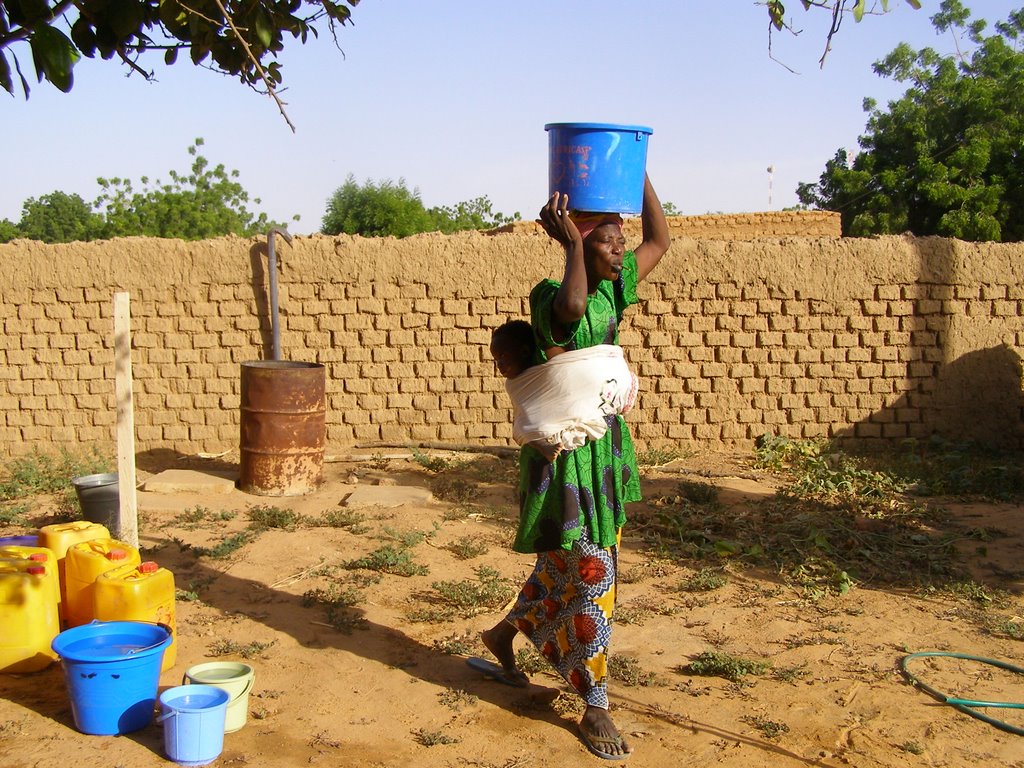
It is usually the women who go get the water and bring it home in buckets on their heads. In Tera they don't usually have to walk too far to get water, but in recent years we've had water shortages as the underground aquifers slowly dried up. In 2005, the last year we were in Tera before our year in the US, we had no running water in our house from January utnil June. We were at the end of the line and on a hill to boot, so our water pressure always went down first. We had to take are buckets and jerry cans to a pump a quarter of a mile away and leave them in line there, coming back several hours later to pick them up. We often had to do this two or three times a day. And that only covered our drinking and wash water. Think what this did for the Africans. They had to walk farther away to get water and carry the heavy load. Donkey and ox carts did a brisk business carrying barrels of water to thirsty households which often inclueded animals.

Last year, the town of Tera dug some new wells, and that alleviated the water shortage, but did not completely solve the problem. There were still some water shortages last year, but they started later in the dry season (like February). We expect that we will have shortages again this year. What usually happens first is that we'll have low pressure or no pressure during the day, but we'll have water at night. We would then have to get up in the night to fill buckets, barrels, or whatever container we might have. Later, the pressure will start decreasing at night until it is only there early in the wee hours of the morning. Finally, we'll have no water at all.

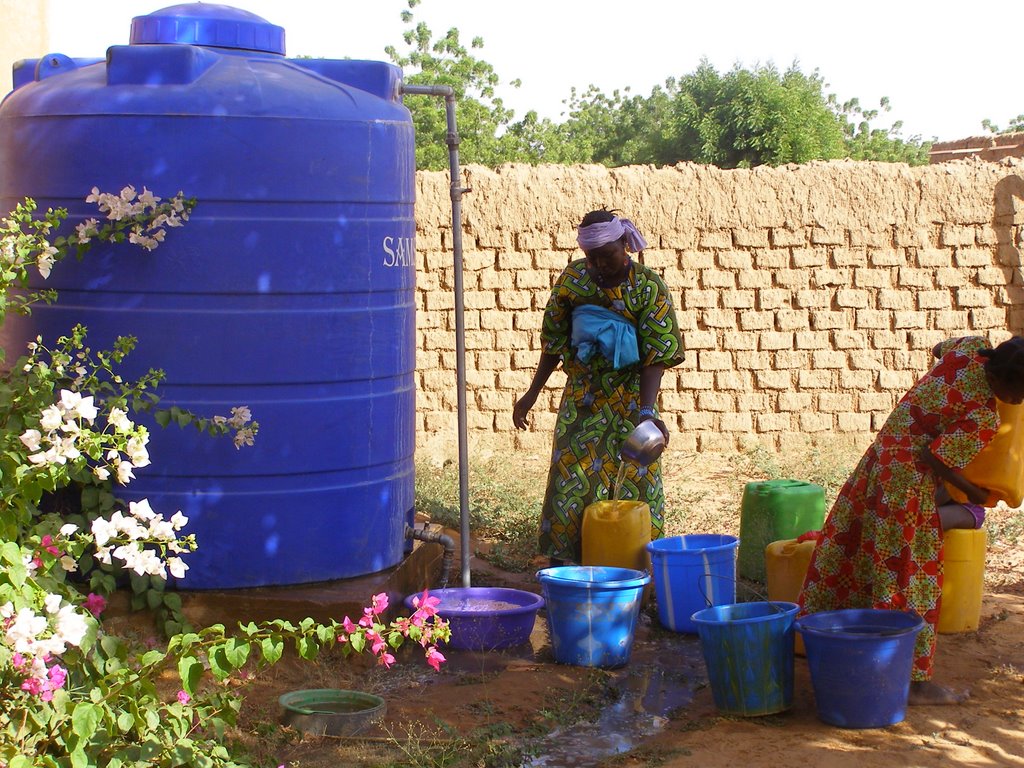
In order to alleviate stress and prevent us from having to go searching for water every day, we installed a big 2,000 gallon water tank with a pump in our yard. It has a float valve in it which cuts off when the tank is full. It pumps the water up into our pipes when the pressure is low. Best of all, it can fill up in the middle of the night without us having to get up. That way we'll have water the next day even when there is no pressure. As long as there's some pressure in the night, we should have water the next day.

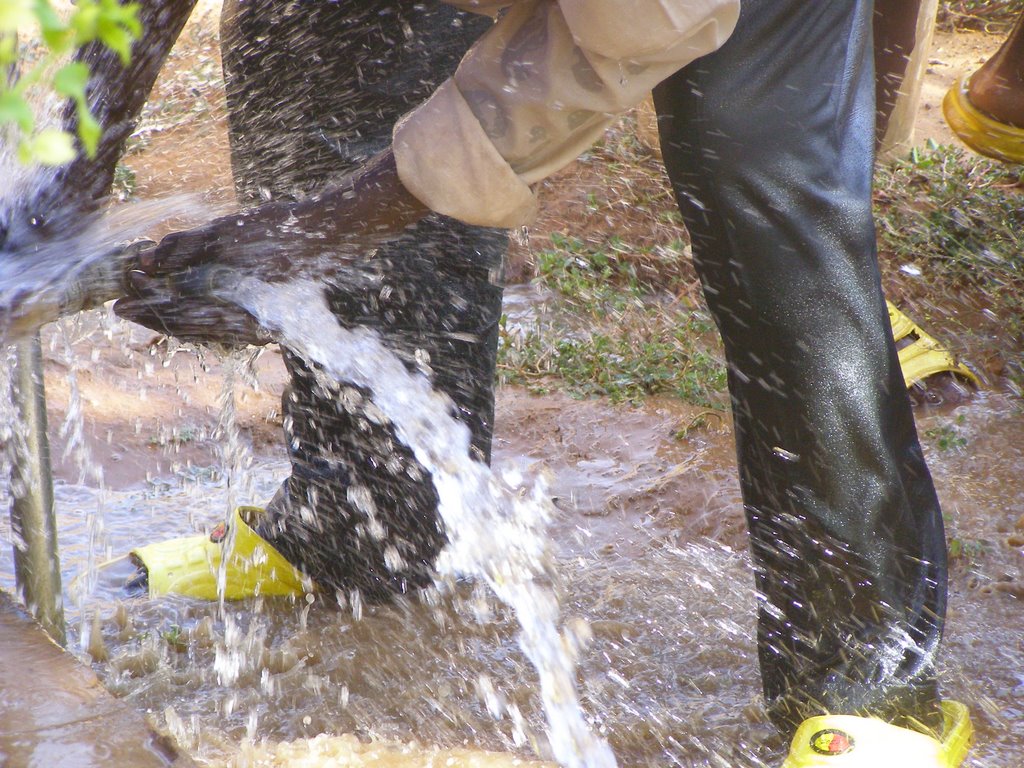
There is spigot on the outside of the tank, so we can fill up buckets in the yard. Recently, water started leaking from around the spigot pipe where it goes into the tank. We called in a plumber, and the pipe came off the tank into his hands, spraying water everywhere. He said we needed to empty the tank so we could repair and clean it. We decided to do it then and there. But it would have been a waste to spill it all on the ground and have it go for nothing. So we invited the neighborhood women in for free water, and we also got some for ourselves. Nancy had planned to start her women's group that day, but we cancelled that and had a women's water party instead. It was great fun as all water broke loose and the tank was emptied.


All the women came in and were rejoicing over the free water.


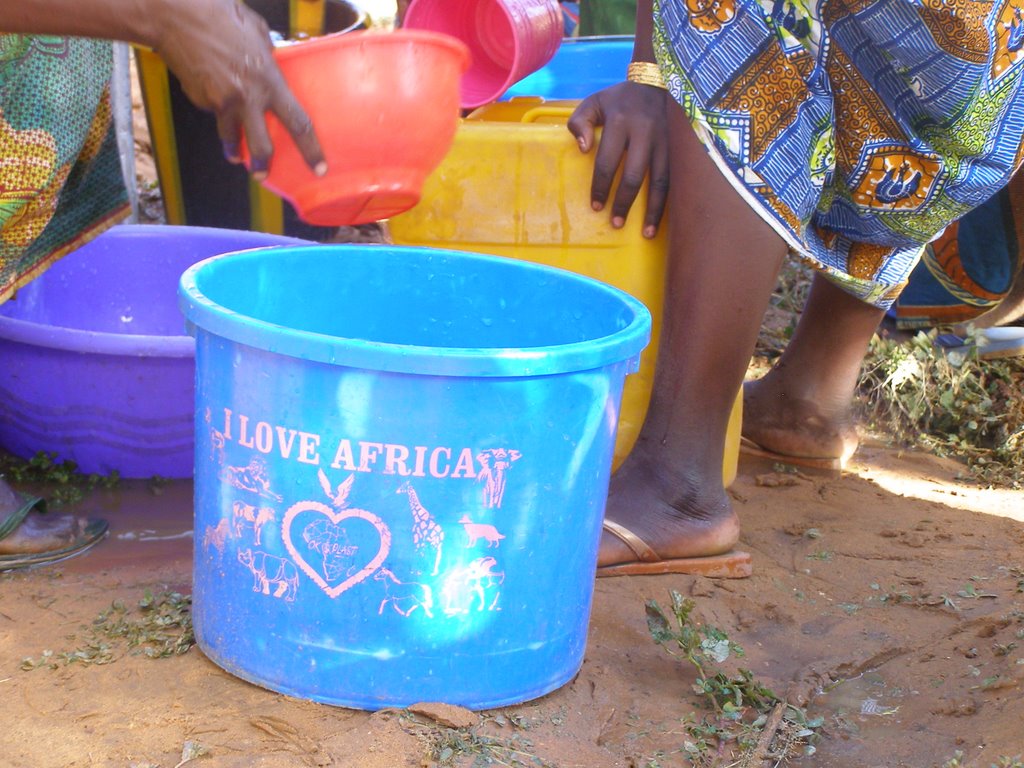
Finally, I want to show you a picture of one of the buckets in the yard. Can you see what it says on it?

10.11.06

You Can't Raise an Elephant in a House

--Songhai Proverb

How would you announce your engagement? Try this idea on for size.

One day we were at the home of some friends. Our cell phone beeped telling us we had a text message. This was the message:

"Please pray for me. I am planning to get married to Z___.

Amadou"

Now we have known Amadou for several years. He is an intelligent young man from the Gourma tribe who lives in Tera. He became a believer during our last term, hungers to know God, and yearns to tell others about Him. We had prayed for a wife for him and had even talked about trying to arrange a marriage for him. But this was the first we had heard of any intentions he had about any girl. So it came as quite a surprise to us.

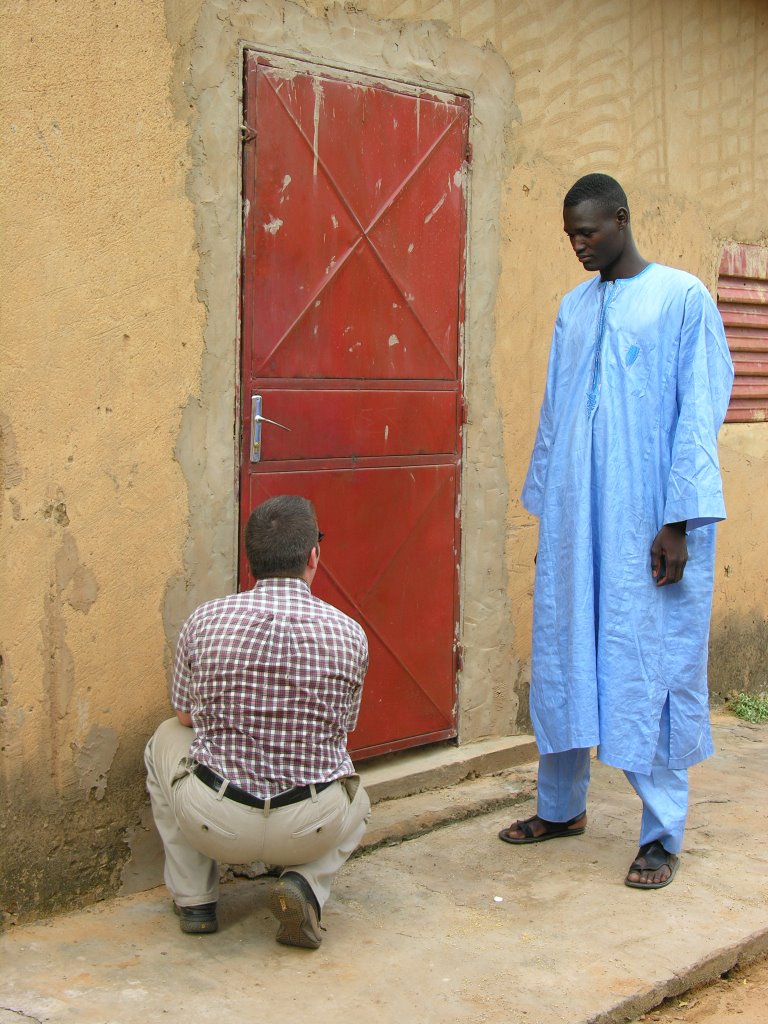
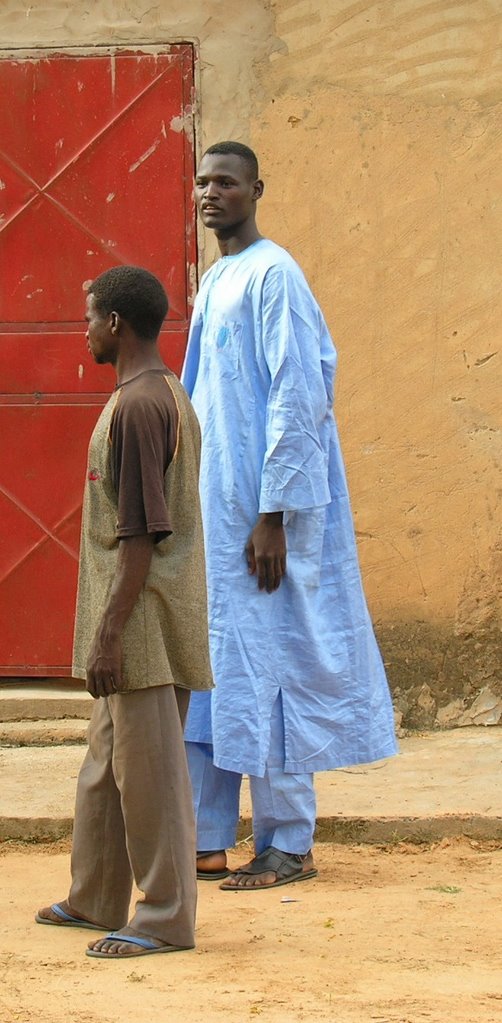
Not only this, but Amadou is extremely tall. When you see him sitting in a chair, you aren't aware of how big he is.

But when he unfolds his long, lanky body and climbs out of a chair, his height becomes apparent. He is about 6 feet 5 inches, and he dwarfs those around him. In fact he is sometimes known as "giant" or "Goliath." He has to duck to go in and out of many doors to avoid hitting his head.


Amadou will be marrying a Christian girl from the Baptist Church in Tera. I don't yet have a picture of her, but I hope I'll be able to post that in the near future. As far as we know, this will be the first Christian wedding in Tera, and we'll be setting a precedent for others to follow because we'll be creating new customs and replacing cultural practices with Biblical ones, we hope. So this will be quite an adventure. We don't have a wedding date yet, and that won't be set until one or two months before the wedding, but it will likely be sometime in mid to late 2007.

Now you're probably wondering what in the world the Songhai proverb above has to do with this story. Well, when I saw Amadou after receiving the text message, I asked him if he had informed many people about his intentions. He said, "No," and then he used the Songhai proverb, "Tarkund'ize si biiri huwo la." Those are the Songhai words for the title above, and they mean basically that you can't keep a big secret for long. I said I'd never tell, but the way the grapevine travels in Africa, once the secret gets out, the news travels fast.

What makes the proverb doubly meaningful is that Amadou is so big, he's like an elephant, or at least a giraffe. And you can't raise a big animal in a house like that because it will eventually burst the bonds of the house.

So, that's the secret. Don't tell anyone I told you.

26.10.06

The Back Road

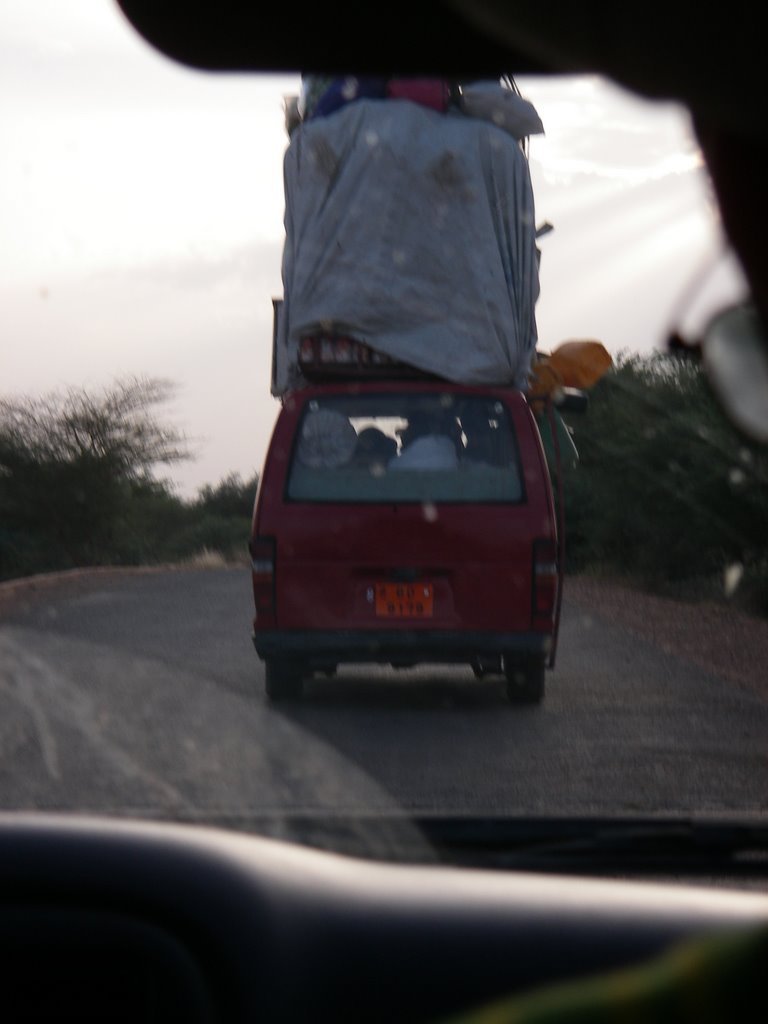
There are two ways to get from Tera to Niamey. One is by taking the paved road from Tera to the Niger River 100 km away. Then you take the ferry across the river to a paved road on the left bank which runs directly into Niamey. That's the easy way. Along the way you often see scenes like the one at the left. Note that the stuff on top of the van is higher than the van itself. Is this van top heavy or what? Maybe we should try this with airplanes. We could carry a lot more luggage.


The other way to Niamey starts out the same. You take the paved road from Tera to the Niger River, but instead of taking the ferry across to the left bank, you turn off onto a dusty, unpaved road on the right bank which parallels the river. We affectionately call it "the back road." Only real missionaries take the back road. It is a bone-jarring, teeth-chattering, head bashing rocking and rolling ride. The road has moon-sized craters, hard washboard abs to die for, sand dunes in the most unexpected places, road hazards like cows and people and thorns, bushes along either side which totaly obscure the view, choking dust, and pebbles which when thrown up by passing cars can smash you windshield to smithereens. Also, the road has huge potholes which can swallow your car whole. Be on the alert. Here is a picture of the road.


So when we turned onto the back road on Sunday, Ocotber 15 on our way to Niamey, I told the kids to hold onto their chins because they were going to get jerked around. They were.


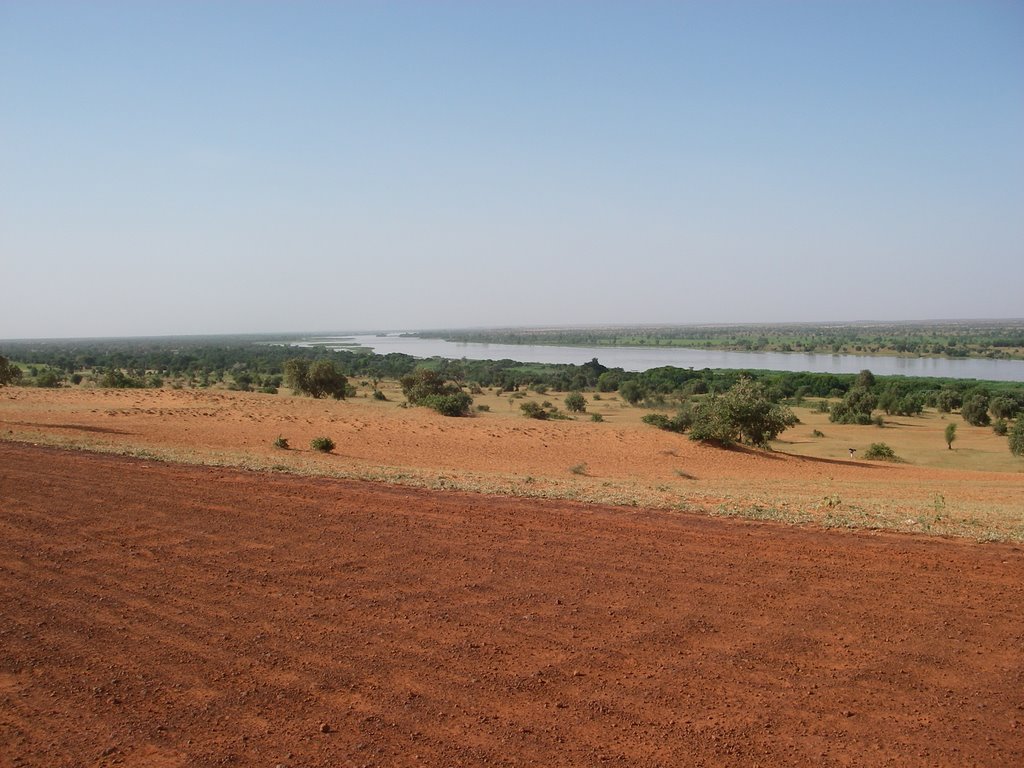
One nice thing about the back road is the scenery. At one point, the road tops out on a sand dune high above the river, and a beautiful panorama unfolds. The whole valley of the Niger is spread out at your feet. This picture does not do it justice.


After our stop for pictures on the dune , Daniel decided to try his skills as a hood ornament. He didn't fare too well.

After 60 km and nearly one hour of bumping, rolling, and jerking, you finally reach the end of the road, but not without one final obstacle: a washed-out bridge. You have to cross about 300 meters of deep sand which is the bed of a seasonal river. Only occasionally do you see water in it. With our four wheel drive truck we have no trouble crossing, but more than once we have seen cars stuck in the sand.

What a relief to get to the smooth, paved road coming from neighboring Burkina Faso and heading into Niamey! Then all we have to do is cross the bridge in Niamey (the only bridge on the river between Nigeria and Bamako, the capital of Mali) to get to our destination. On Sunday, Ocotober 15, we made it in one piece, only slightly the worse for wear.

The next morning we woke up to find a thorn in one of our tires. Yes, it was flat! That's life in Niger.

7.10.06

A Naming Ceremony and What Happened There

In every culture there are life change points. The most important of these are birth, marriage, and death. The rituals surrounding these life change points tend to reflect the prevailing beliefs and mores of the people, and many people follow closely the pattern laid down for the rituals, preferring not to offend the prevailing deity and the society at large. This is especially true in traditional societies.

One of the most important rituals associated with birth in the culture and country where we live is the naming ceremony, called a cebe (pronounced "chay-bay") in Songhai. On the eighth day after the birth of a child, the family and friends gather together early in the morning not long after sunrise to name the baby and celebrate the birth. The men sit on mats or chairs outside the house or even in the street while the women gather together in the house or on the porch and sit on mats. Guests bring small monetary gifts to share with the family. Friends of the father pass out kola nuts or dates to all the guests as a symbol of friendship and hospitality. The baby's head is shaved. Then someone slaughters a ram which will be put in the pot for the stew to be made for all the guests at midday. Meanwhile, the name is announced by the religious teacher and everyone begins to pray in Arabic. The prayers go on for about five minutes, and then everyone leaves to go about their busines until noon, when they all come back for the feast.

With the new believers in Tera, we have developed some of our own rituals which complement the culture but also incorporate some elements of baby dedications in western-style churches. I believe these are more true to the Bible and to the spirit of what we find in Biblical times. After all, the Jews had a ritual similar to the naming ceremony when they brought the child to the Temple on the eighth to be circumcised (if it was male) and to offer sacrifices.

When I go to naming ceremonies amongst the believers, some of the same things happen that happen in the culture. The men sit outside the house while the women sit in the house or on the "porch." I as the religious teacher announce the name of the baby. Often I am given the privilege of choosing the name, especially amongst people who are less literate and live in rural areas. A meal of rice and sauce with goat or sheep meat will be prepared for the guests, but the animal won't be slaughtered right at the moment of the naming as in the prevailing culture around us. Usually, a small gift of kola nuts or dates will be given to each guest. Guests will in turn bring some money to give to the family. We will have a time of prayer for the family and the baby, but in Songhai, not in Arabic.

However, I add some elements that I think make it more meaningful and Biblical. First, I talk about the fact that God loves children and holds them in His hand. I read such passages as Prov 22:6; Psalm 127; or Mark 10:13-16. I then give a short gospel presentation and afterwards I read a charge to the father as the representative of the family to exhort him to a godly example and training of the child. Then I announce the name. If I've been given the privilege of naming the child, I choose a Bible name and first talk about that character in the Bible. After a prayer, I go to the house where the mother is and pray for the mother and the child. I usually take the child in my arms and hold him/her while I am praying. I always pray the prayer of blessing from Numbers 6.24-26. Then if Nancy has not gone to the cebe I give the mother the gift of an outfit for the baby which my wife has chosen ahead of time.

This is the time of year when there are a lot of cebes. We have attended many in town among non-believers and also some for believers. I have been given the privilege of praying for the family in a village outside of Niamey. In another village, I have assisted at two Christian naming ceremonies, one in September, and one on October 1. At both of the latter, I was given the privilege of naming the baby. I named the first Yakuba (Jacob) and the second Ayuba (Job). Yakuba was quiet and slept through my prayer of bessing for him. Ayuba was a rascal. Not only did he scream and yell when they passed him to me for the prayer, but as I was praying, Ayuba decided to let loose from another end. No sooner had I begun to pray than Ayuba peed in his pants. Actually, to be more accurate, since babies in Africa don't wear diapers, he peed on my pants. He was covered in a cloth, but it was very thin, and the liquid quickly soaked through and onto my pants. Then I heard a soft gurgling sound, and the liquid on my pants started turning yellowish-brown. At this point, the mother noticed my predicament and her friend sitting there snatched the baby away and started pouring water all over my pants with a plastic tea kettle so common out here that people use to wash. Meanwhile, I continued my prayer of blessing as though nothing had happened. All was proceeding as normal. This is not an uncommon occurrence for me, but it doesn't happen all the time. Anyway, we finished the ceremony without any further ceremony or interruptions, and the baby was properly named and dedicated.

Now that is a story to write home about.

25.8.06

A Wild Journey to AFrica, Part Four

This will be my last installment in the saga of our journey to Africa. It was quite a trip, but after a nice time in Paris, we still had half the journey to go.

As an aside, some may wonder how I got to know Paris as well as I do. Including this unexpected layover, I have been in Paris four times for at least an overnight. The first was in 1975 when I got to stay in the city and see a few sights as a teenager just learning French. I was with a short-term team that passed through Paris both coming and going on our way to Marseilles, the second largest city in France on the Riviera. The last time I got to see Paris was when our son Daniel was little (one year old). That year (1990) Nancy and I did some touring around Europe on our way home from Niger. But the reason I know Paris so well is because of the second trip I took there in 1980. I was taking a course from Houghton College during the month of May that year (the same month Mt St Helens blew its top). It was the easiest A I ever got in college. Oh, we had to write a paper in French on some aspect of the city (I chose to write on the history of the metro and trolley systems) and keep a journal (in French). We also had to attend a conversation class at the Alliance Francaise, a French university, taught by a real French teacher. But the best part of the course was that we got to tour the city from one end to the other. We saw all the major tourist attractions and lots of the smaller ones that tourists often don't know about like the Catacombs, the church of the Madelaine, the Pompidou Center, the Monet museum, the opera house, and the Paris zoo. We also learned to use the city transport systems and get around town. I also learned a lot of French during that month. It gave me some great memories. I stayed on in France for most of the rest of that summer and spent some time with AWM both in the south of France (Grenoble, Marseilles, and St. Etinne) and in Algeria. I had many opportunities to practice French, and that's when I really learned it well.

On with the story of our trip:

9 a.m., Sunday, 13 August 2006 (Paris time)
I wake up and rouse my family so we can get down to the zero floor for the hotel breakfast. We fill up on croissants and cereal and return to our room to pack our carry-ons.

11:15 a.m.
We meet the Sauers and Jeremy at the Gare du Nord and use our round-trip train tickets to get back to the Charles de Gaulle airport.

12:30 p.m.
We join the queue (get in line) to check in for our flight to Casablanca, Morocco. It takes a long time to get all our baggage checked, even thought they have it all stored in the bowels of the airport. We are told that all our baggage might not get on, as it's a much smaller plane than our flight from New York, but if it doesn't, the worst case scenario has it coming on the Tuesday Air France flight from Pars directly to Niamey. Then we get our boarding passes for both flights (Paris-Casablanca and Casablanca-Niamey). Finally, we're ready to pass through security.

2:30 p.m.
We pass throught a much shorter security line than we had had in New York and head to our gate. We don't have long to wait.

3:00 p.m.
We board our plane. As we get on, the agent checks our baggage, and all but three pieces are already tagged as being on the flight.

3:40 p.m.
Our flight takes off almost on time with almost no waiting on the runway. (We were scheduled for a 3:30 p.m. take off. In flight we are served a cold lunch that doesn't taste very good. There are no video screens on this flight and no movie.

4:25 p.m. (Casablanca time, 4 hours ahead of EDT)
We land in Casablanca slightly ahead of schedule after a flight of about 2 hours and 45 minutes. We go to the transit lounge and wait and wait and wait. We try to while away the hours by playing games (we had some card games with us), talking, eating, walking up and down the transit area, and visiting the duty-free shops. Casablanca has a nice airport except that there is no non-smoking area. The seats are comforatable, but many of them are taken, at least initially.

9:00 p.m.
Our gate opens up and we move from the transit lounge to the boarding area. We wait some more.

10:15 p.m.
We begin boarding, nearly six hours after arriving in Casablanca. A bus takes us from the gate to our plane parked out on the tarmac somewhere. As we approach the plane, I see our boxes being thrown (literally) in the cargo hold. I pray that all our computer equipment makes it without being broken. (We learn later that everything has come through the ordeal in.)tact

11:00 p.m.
We take off about ten minutes late. Though this plane is older than the previous flight from Paris, I like it better. We are served a delicious hot meal and given a pillow, blanket and in-flight kit which includes socks, an eye patch, and earphones (none of which we had on the previous flight). The flight is more than half empty, and we get to sit in the emergency exit aisle where there is more leg room. What's more, the cabin has monitors which show the progress of the plan across the Sahara. I doze off for about three hours.

3:15 a.m., Monday, 14 August 2006 (Niamey time, 5 hours ahead of EDT)
We arive in Niamey about ten minuets early. We are dog tired. After walking down the ramp, we get in a bus, and it makes a U-turn, dropping us off at the entrance of the terminal (about 50 paces away). We could have walked there faster. We get throught immigration and health checks without incident and enter the baggage claim area. A porter helps us collect our baggage. After an hour, it appears certain that two of our bags are missing: one of the guitars and the suitcase with clothes and medicines for Nancy and I. I have to make a declaration of the missing baggage. Though the line is not long, it seems to take forever, and I can't stand any longer. I lie down on the ground in the missing bag claim area. I am the last one on the flight to declare my missing baggage. The Sauers are also missing a bag and so is Jeremy.

5:15 a.m.
No one has come to meet us at the airport. Apparently there was some confusion about when we would come. Fortunately, someone is there to meet the EBM couple, the Totmans. He rouses some of our SIM people on his cell phone (everyone has cell phones now), and they arrive before we actually clear customs. No one opens our bags and everything clears customs without hassle. Thank you, Lord! We are the last people to leave the airport. We load all our baggage (our 25 pieces and Sauers' 17 pieces) into two vans and a pickup. My legs give out under me in the parking lot, and I collapse. I'm wiped out!

6:00 a.m.
We finally get to bed after a long and tiring night. We have had two 36-hour periods in the past four days with little or no sleep. We are staying in an apartment above our field office. It is a gift from God. We sleep until about 11 a.m. and then hunger pangs wake us. Nancy and Suzanne go out to find something to eat and have to walk back in a heavy rain shower. They get soaked.

1:00 p.m.
The kids take a taxi over to Sahel Academy across the Niger River from where we're staying. They stay all afternoon.

Wednesday, 16 August 2006
First day of school for Daniel and Suzanne. There is an assembly in the morning which Nancy and I attend. We meet some of the new staff and parents. There are some new faces amidst the old, and there are some who have come back after a long absence. This day marks the 20th anniversary of the beginning of Sahel Academy. It is also our 20th wedding anniversary. We go out to celebrate in the evening at a local eatery. The food and ambiance are both good. After dinner, we go out to the airport and check to see if our two missing bags have arrived. They have. We retrieve them and return to Niamey. Our saga has ended a week after it began. Whew! We made it. Now for the hard stuff.

22.8.06

A Wild Journey to Africa, Part Three

Our satelite server has been down for about 36 hours, so I was not able to post the rest of the story of our trip yesterday. Here is what happened on Saturday, August 12.

One of our supporters wrote and reminded us of the phrase, "When life hands you lemons, make lemonade". That is exactly what we did on the this day when we were stuck somewhere we hand't planned to be.

9:30 a.m. Paris time (six hours ahead of EDT)
I wake up after a decent night's sleep. Fortunately, I didn't have a drug overdose or a drug interaction during the night after all the medications I had taken (see the previous blog). I thought of that just before going to sleep.
It is raining. When I walk down to the lobby (we are on the sixth floor, or if you live in Europe, it's called the fifth floor), I am told the forecast calls for occasional showers. Not the best day to see the city, but we'll make do with what we get. First, I go and find the Sauers and Jeremy at their hotel around the corner. We go out to find a place where we can exchange some dollars for euros without getting robbed. When I get back to my family, Nancy goes out to a local grocer to find some food.

1:00 p.m.
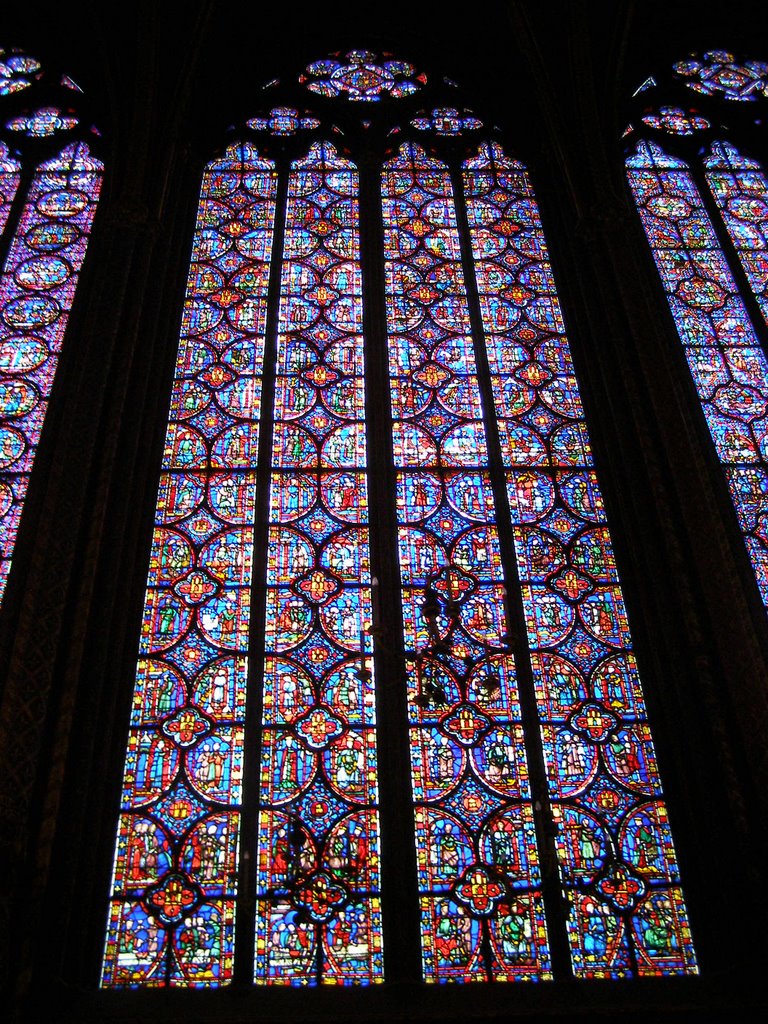
The nine of us head for the Gare du Nord (train station). We buy an all-day pass (Mobilis) which allows us to ride any of the city transport systems for one whole day. We will use these passes a lot during the rest of the day, getting our money's worth out of them. We first head to the Ile de la Cite (the Isle of the City), the center and oldest part of Paris. Notre Dame is on the Ile de la Cite, but I tell my tourists that the best church in the city is la Sainte Chapelle (the Holy Chapel), a "tiny" Gothic cathedral built in the 1240's for the royalty of France. It is just around the corner from Notre Dame. When we come up out of the metro, it is raining, and we get soaked waiting in line to enter la Sainte Chapelle. The cathedral was built to house the supposed crown of thorns which Jesus wore, but today it is best known for its 13 spectacular stained glass windows (including the rose window), two-thirds of which are original. They cover 6,458 sq. ft. of wall space and tell the story of the entire Bible, including the Apocrypha. The dominant colors are reds and the blues, and the celing seems to disappear in light. No picture can adequately capture the heavenly vision, but here is a shot of one of the windows.


2:45 p.m.
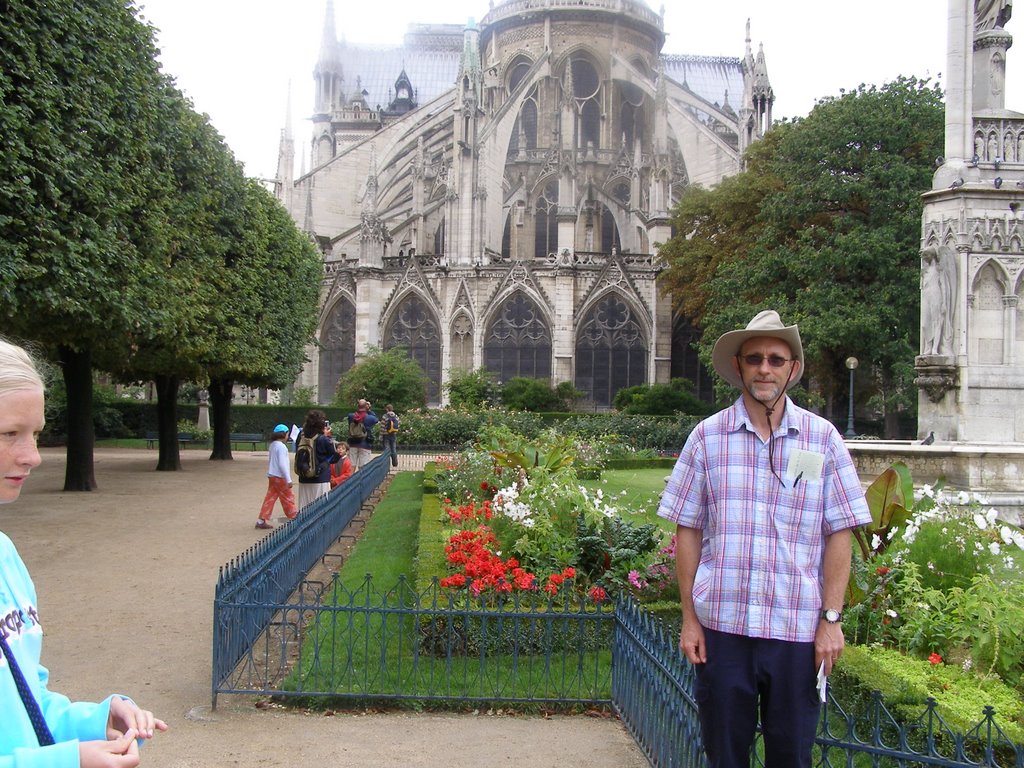
By now the rain has stopped, and we head out of la Sainte Chapelle and around the corner to Notre Dame. Since the line is long, we decide not to go into the cathedral, but instead walk around it and admire the architecture. We also see the Seine River, which bisects the city. Here I am with the back side of Notre Dame behind me.


3:30 p.m.
We reboard the metro and head over to la Tour Eiffel (I don't think that needs any translation). We have to change trains once and take a different line. It is fun trying to find your way around Paris and push your way through the crowds! When we get to our station, we have to walk about four blocks along the Seine to get to the tower. Daniel, Suzanne, Luke Sauers, and Jeremy have the energy to climb the 700 steps to get to the second level (to get from there to the top, you have to take an expensive elevator, and we didn't have the money for that). The rest of us stay at the bottom and rest on the benches in the partly sunny weather. It is cool, but pleasant. We watch the tourists and policemen and pigeons walking around under the massive iron tower. The architect is the same man who designed the Statue of Liberty in New York.

5:30 p.m.
We retrace our steps and board a train for the north side of Paris. We have to change trains again, but this time our first train comes to the end of the line. At the end of the line, you can get out on either side of the train, and the Sauers and Jeremy, riding in the car in front of us, get out on the wrong side of the train. We wait for the next train to come into the station, and they walk on and walk right back off onto the right (left) side to join us. Are you confused? So are we. We board another train and take it to one of the most visible and interesting sites of Paris: le basilique de Sacre Coeur (the Sacred Heart Basilica). The church stands on one of the few hills in Paris and is known by its distinct shape and color (white). It is really pretty in the setting sun, as you can see. We don't walk up the hill to the church as our feet are getting pretty tired (especially those who climbed the Eiffel Tower), and we're also hungry, so we do decide to eat our supper in the plaza at the base of the hill. We find that most delectable of French "fast foods": a croque monsieur (a sandwich with ham in between the slices of bread and French cheese roasted into the bread on the outside). Some of us also have crepes with nutella sauce. We watch the pigeons in the plaza and try our hand at feeding them. Suddenly, a wild cat jumps out the bushes on the plaza and clamps its jaws on one of the pigeons. The pigeon barely manages to escape, but at the cost of losing most of its back feathers. There is an explosion of feathers and the cat is covered with them. We all have a good laugh.

8:00 p.m.
We head back to our hotels just a few metro stops away. We are tired but glad we got the chance to spend some time seeing the city. Jeremy goes out and sees more of the town during the later part of the evening. I wake up after an hour and a half of sleep, but this time I don't have a headache and get back to sleep fairly easily. I don't take as many medications as the night before. It rains heavily in the night.

I will post the last phase of our exciting saga tomorrow. Until then!

20.8.06

A Wild Journey to Africa, Part Two

Noon, Friday, 11 August 2006 (Paris time, 6 hours ahead of EDT)
Our plane touches down on a runway at Charles de Gaulle airport outside of Paris. We cherish a slim hope that they might have held our connecting flight up for us (it was scheduled to leave at about 11:10 a.m. Paris time), but by the time they bus us from the airplane, which is parked way out in the bush, to the terminal, we read on the departure screen that boarding has closed for our flight. No reason to rush now. We're going to be here a while.

1 p.m., same day
We take the shuttle bus from terminal 2C to the terminal where we were scheduled to depart for Niamey. We have to stop at every other possible terminal, first 2A, then 2B, then 2D, then 2F, before finally arriving at 2E . We find the transfer desk and immediately recognize colleagues Dave and Anora Totman and their two small children, who are with EBM. Dave is the youth pastor at Sahel Academy, where Daniel and Suzanne attend school. They had also missed the flight to Niamey. We are not alone in our plight (or should I say flight?). We get in line and shortly afterwards SIM colleagues Ralph and Meridee Sauers with their two children come into the room accompanied by a short-termer going to Niger with the Assemblies of God. They had also missed the flight. So there are 13 of us in this together. What a relief that we don't have to face this by ourselves. It takes nearly three hours to get through the line. Meanwhile, everyone is tired. Here is Daniel expressing what we all felt at that moment.

Because there are only two flights a week from Paris to Niamey, and because we had so much baggage, it took almost two hours to get another booking for our destination. But we would have to spend two nights in Paris--at our own expense!! At first the airline wanted us to collect all our baggage for security reasons and take it with us to the hotel, but we simply refused to do that and tried to explain how impossible that would be. Finally they relented and agreed to keep the baggage for two nights. We asked if the baggage couldn't go on the next Tuesday flight to Niamey and we go on another flight. They said the baggage had to accompany us. So, after five hours of standing in line and waiting, we are finally booked on an Air France flight to Morroco on Sunday, 13 August, with a connecting flight to Niamey the same day.

5:45 p.m.
Nine of us (excluding the Totmans) proceed through customs with just our carry-ons and proceed out into the main lobby, where we have to make our own hotel arrangements. We elect to go into town because it is cheaper. After some searching, we find two hotels near each other so we can be together. It will just mean a 30 minute train ride to get to the center of town.

6:45 p.m.
We board our train and head into Paris. Suzanne has never made this trip before, but the other three of us have all visited the City of Lights at some time. We find our hotel and check in. It is called the Hotel Metropol. For those of you who know Paris, it is near the Gare du Nord. We leave our baggage and go out to find something to eat.

8:00 p.m.
Due to the latenes of the hour, we decide to eat at a street-side cafe in typical French fashion. We are only a block from our hotel and across the street from the Gare du Nord. We order the menu, which includes a choice of an appetizer, a main course, a drink, and a dessert or cheese. I have tomatoes with a tasty vinaigrette, pepper steak with fries, a bottle of apple juice, and an apple tart. It is delicious and really hits the ravenous spot. Here is a photo of the street at the restaurant.

10:00 p.m.
We head back to the hotel and get ready for bed. We are naturally exhausted. I fall asleep immediately, but after a two-hour power nap, I wake up and cannot fall back to sleep, so I take a Tylenol PM. I have a tension migraine and take some Ibuprofen. I can't breathe due to my allergies, so I take some Nasonex. I am in a panic and my heart is beating furiously, so I take some panic medication. The room is hot and I'm sweaty, so I crack open the window even though it is cold and blustery outside. I have to go to the bathroom. Finally at about 1:30 a.m., I fall back into a deep slumber and sleep the sleep of the dead until 10:00 the next morning.

That was day 2 of the saga. I'll post more tomorrow.

A Wild Journey to Africa

As journeys go, this was one of the most arduous and exciting we have ever expereienced in all the 22 years we have lived in Africa. I'm going to give you a blow by blow journal of events starting with the afternoon before our departure.

2 p.m., Wednesday, 09 August 2006
I call Air France to check on our baggage. We have 27 pieces that we want to take onto the plane, 19 of which will be going as excess baggage. Even though we pay $150 for each excess piece (maximum of 32 kg each), it is the cheapest way to get the things we need to the field. I have been calling for the previous three days to get the baggage approved for the flight. There is still no confirmation of the baggage going on the flight, and a check with the office in Paris reveals that the Paris office is closed for the night. Panic begins to set in. I call Jim Knowlton, a colleague with SIM, to ask him if there is another way to ship our bags. He says the container going to Niger is full and to ship air freight would almost certainly result in a 65% duty slapped on our goods on arrival. He tries to call the airline without success. I hand the packing list to Daniel to have him look over the contents and decide which pieces of baggage are priority and which could be left behind to ship another way, if necessary. We decide that there are 11 excess pieces that must go on the plane with us, leaving 8 that could come later. The boxes that must go have all the computer equipment and the most valuable stuff in them. I start estimating the value of the contents of each piece that could be left behind. The rest of the evening involves packing.

7:45 a.m., Thursday, 10 August 2006
I am roused from bed by a phone call from Pastor Terry. I had slept in due to the exhaustion from the night of packing, but I was awake. Terry asks me if I have heard the news. I say, "No." He informs me of the plot to blow up 20 planes in mid-air traveling from England to the US. He says the threat level has been upgraded and security at airports has been increased. We must take all liquids, gels, sprays, and medicines without our names on them out of our carry-ons and put them in our checked luggage. Frantic unpacking and repacking ensues.

8:15 a.m., same day
I call Air France. Our baggage still is not approved, but there seems to be some misunderstanding about how much baggage we have. The airline thinks we have 480 kg of excess per person!! Our total excess turns out to be only 550 kg. That's still a lot, but a long ways from what they think we have. Did every agent I call on the previous four days submit a new request for baggage? I call Jim Knowlton again and plead for help. He gets on the phone with Air France. I call Pastor Terry to inform him of our predicament.

8:50 a.m.
Jim K. calls to say that our bags are approved to Paris but not to Niamey. He is still on the phone with Air France.

9:15 a.m.
Jim calls with the word that our baggage is approved all the way to our destination. Thank you, Jim! However, the airline requests that we remove Daniel's BB gun from one of the bags and also take print cartridges out of both printers. More frantic unpacking and repacking. The BB gun is shipped to our headquarters in Charlotte for probable shipment on the container.

9:45 a.m.
We sell our van. This had been a big item hanging over our heads.

10:15 a.m.
The church van arrives to load up our baggage. It goes first to the MRF storeroom where we had been putting our bags after we had packed them. Then it comes to the house to load up the last pieces. Everything fits, and there is even a space between the ceiling and the boxes to see out the rear view mirror.

11:15 a.m.
After final goodbyes and a prayer with those gathered, we leave for JFK airport in New York with Pastor Terry as our driver. We have had enough of goodbyes and are sad to leave all our friends old and new behind. We wish it would get easier, but it doesn't.

noon
We stop at a Subway in Matamoras, PA to get some food to fortify us for the trip. It will be our only real meal for the next twelve hours. Jim K. calls us on Pastor's cell phone to tell us to hurry it up and get there as quickly as possible.

1:45 p.m.
We cross the George Washington Bridge into New York City. Traffic gets much more crazy, and we are getting anxious to get there. We don't experience any major traffic congestion on our way into the airport.

2:30 p.m.
We arrive at Terminal 1 at JFK airport. We quickly find the Air France desk, but getting all our baggage up to the counter is a big job, even though it's not very far. We hire four carts to lug it all, but it takes several trips and a lot of time and effort. It takes us over two hours to check in all our baggage and weigh it, but thankfully the agents at the desk can see the approval for the baggage on their computers and don't question the number of pieces or the weight.

4:45 p.m.
We head for the security line to go past customs to our gate. Predictably, the line is long and slow, and Nancy and Daniel get in a longer line. They discover some things in Daniel's carry-on that he had forgotten to remove, and they confiscate them. We have to take a lot of things out of our carry-ons to show them to the security people. Thankfully, they let me keep my Nasonex spray.

5:30 p.m.
Cleared through customs, we walk to our gate at the end of the concourse. We walk right onto the plane as boarding had started 10 minutes previously.

6:05 p.m.
Our scheduled departure time comes and passes. We wait in our seats in the plane. Eventually the pilot comes on to inform us that there are 20 people supposed to be on the flight who are still trying to get through security. Later, after a count of the number of passengers, he informs us that one passenger did not get on but his baggage did. The hold must be opened and the baggage removed. We pass another 30 minutes waiting.

7:45 p.m.
Still at the gate. By now the sky is becoming black, and it's not because the sun is setting. A tremendous storm is approaching from Manhattan Island, and the wind begins to pick up. We are not cleared to leave the gate. The storm hits with a bang and a shudder at about 8:30 p.m., and we are grounded. Around 9 p.m., the pilot informs us that the airport has been closed. We are hungry and ready to climb the walls of the enclosed cabin. Everyone is getting up to walk around and get something to drink.

10:30 p.m.
We have now been on the plane five hours, but it has not moved one centimeter. However, the storm is blowing itself out, and the airport is reopened. Finally, at about 10:35, we pull back from the gate.

11:30 p.m.
Lift off! We are served a nice meal on the plane, and then I actually doze off for about 3 and a half hours. I never sleep on planes, but I am so exhausted from the frantic pace and all the uncertainties that I do sleep this time. We are fairly certain we will miss our connecting flight from Paris to Niamey, as we are six hours late, and we only had a scheduled layover of 3 and a half hours.

That is just the first day of the journey, and there are still four more to go.

5.8.06

It's a Moving Experience

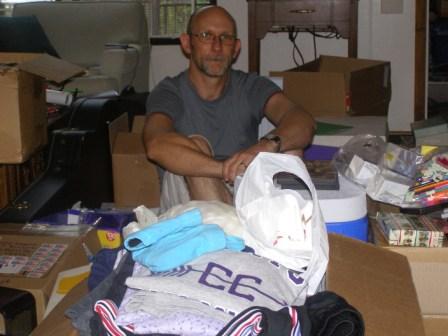
Wow! It has been a long time since I posted on my blog. Sorry to all of you who were hoping for something sooner. I was on the road for four weeks (June 16-July 16) and put 4,000 miles (6,500 km) on our cars!! For you European folks, that is all in a day's work in North America. Traveling is tiring, but I love the speaking and interaction with people. I didn't have access to pictures during that time, and I wanted to post some pictures on my blog, so I wanted to wait. Also, I was busy in meetings, seminars, visiting friends and supporters, and getting some business done. Then since July 16 it has been frantic trying to get ourselves packed up and ready to go. The lists seem like documents, and the mountains of stuff (how did we ever accumulate so much stuff?) to pack were huge piles that needed to be moved. We will be taking 28 pieces of baggage with us on the plane.!! A lot of the stuff is necessary, like computer equipment (how long ago was that not even considered a necessity?), school books, guitars (two of them), language matieral, clothes, and some personal items, but how much do we really need to take? I wish I could just wave a magic wand and have it all be transported to Niger in a few seconds waitng for us in our house when we arrive. Beam me up, Scotty!! With all my stuff. Anyway, here is a picture of me in the midst of the chaos trying to pack and organize it.


By God's grace the mountain has moved and been reduced to a small molehill. We're only five days away from departure, and the list is slowly getting smaller. Anyone who has made an international move knows what it is like to take care of so many details that it boggles the mind: closing down a bank account, getting needed prescription medications, selling your car, calling the airline about excess baggage (we'll have to pay $150 for each excess piece of luggage beyond our usual two pieces of checked luggage per person), getting visas (a stamp in your passport permitting you to enter another country), filing reports and papers, sending out address changes to those who write you and send you information, writing a last prayer letter, setting up a way to work your taxes while you are gone, cancelling insurance for your vehicles, buying last-minute items, writing in your blog, filling out college applications, and a host of myriad other details to attend to. That's in addition to the chaos of packing and the heart-wrenching good-byes which never get any easier. It's hard to sleep with so much on your mind and lots of details to remember. It's easy to misplace items, and then you pack things you realized later you could have used for a specific application during the last days.

It has been a tough home assignment for us. It's not just the changes we're going through, the changes in our mission, the reverse culture shock of living in the US (which is just now starting to wear off), the reality of having teenagers who have had more needs and more likes and dislikes to accomodate, or the financial matters that have preoccupied us. It's more like a combination of all these things plus personal matters and plans for the future.

Even though it has been tought in many ways, we've all grown, and I choose to remember the good things God has given and done. He has provided all of our needs at the right time. I want to sign off with a few pictures from this year, memories I want to cherish forever.

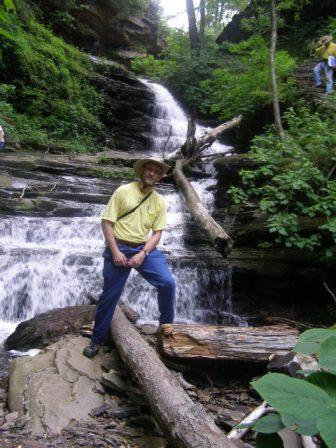
The first picture is from a hike we took in June 2006 just before I left on my trip to Chicago and before the flood which closed down this park. It was taken in Rickett's Glen State Park, a wonderful, backwoods place in PA that I have come to love. I first discovered it when I taught for three years at a school near Williamsport, PA before going to Niger. We hiked down a trail with over a dozen waterfalls, and here is one of them. At the end of the trail (about 4 miles) we had a picnic lunch together in the park picnic site. It was a fun day.


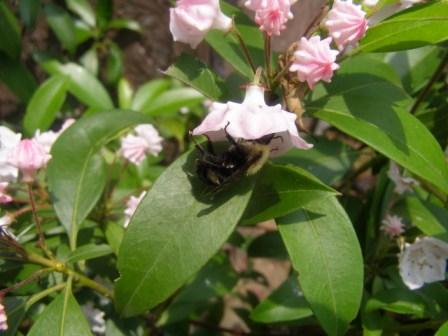
Another picture is of one of my favorite flowers. It's the state flower of both Connecticut and Pennsylvania. Anyone know what it is? It only comes out in the month of June. Note the bee pollinating the flower.


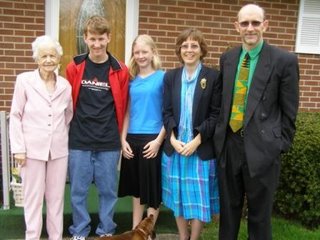
Finally, I want to publish a picture of my family at Easter. We had a great time with Aunt Jeanette and Uncle Carl (actually my wife's great aunt and uncle), both in their 90's. They are the youngest 90-somethings we have ever known and an absolute hoot to be around. We're going to miss them a lot. This picture includes Aunt Jeanette.

I'll publish some more of my favorite photos from home assignment next time around, probably after we get back to Africa, where it's hot and humid right now. We arrive in the midst of the rainy season, and five days after our arrival, school starts for our kids. Daniel will be a senior this year, and Suzanne will be in her sophomore year. Nancy and I will continue our work in Tera, and our kids will board at the school in Niamey, three hours away from Tera. The school they attend is Sahel Acedemy. Thanks for taking the time to read our blogs.

15.6.06

Choices

We Americans have many choices, too many I think. If you walk into almost any supermarket, you can find a gazillion different types, brands, and colors of ketchup. A trip to the fast food restaurant offers a bewildering array of food and drink choices from triples to doubles and super size to small. A Super Walmart Center has so many choices of products and sizes that it can take a long while to find what you want. I find that I often get lost looking over the shelves when I'm looking for a specific product. I simply can't see what I want amidst all the choices. Sometimes there are so many choices I feel paralyzed and can't make a decision what I need or what I want.

What a contrast with our lives in Niger, where there are often few choices of any particular product. Is ketchup in town today? If it is, you will likely find only one or two brands, and it doesn't compare to American ketchup. There are no "fast" food outlets, and restaurants have some choices but not many. There are no Super Walmarts or Home Depots. There are only two "supermarkets" in the whole country, and neither has more than six aisles or has more floor space than a basketball court.

Our African friends are extremely poor and cannot afford the luxuries we buy, like ketchup and meat, or Cokes and toilet paper. They think we have it all. We can get the best health care available. We can buy anything we like to eat (as long as it's available in the country). We can travel freely from place to place without too much hassle. We can take a vacation, something only the rich can afford. They often cannot afford even the $1.60 they need to pay for malaria medicine. They eat millet (bird seed) three meals a day. They don't have adequate public transport or good roads and don't own cars. They often can't afford to travel anywhere.

Sometimes after four years in Niger, we come back to the US and are dazed by the choices here. We want to experience the things we have done without (cold season fruit or nice tennis shoes, for instance) and so are tempted to buy things we don't need or can't use (at least all at once). We want to pack four year's experience into one year at home. We're also tempted to buy something when we see it because "it might not be there the next time." This mentality comes from being in Africa where if you see it you'd better buy it because it might not be around the next time you go to the store. This applies to necessities as well as the little extras of life.

If anyone thinks we don't have enough choices, look at the world of telephones. We have land lines with a confusing array of local and long-distance servers. We have cell phones that come with text, photo capability, and a huge choice of ring tones. Each company or server comes with different options. Or you can use a phone card to do your calling anywhere in the world. Then there is the latest choice of bundling your phone service, tv, and internet all together. Where is all this going? Who can keep up with it? What ever happened to Ma Bell?

Then there's the way we use the word "choice." I deserve to have choices. We want to "choose" our destiny. There are choices of lifestyles and family situations. "The choice is clear," says the commercial. Some people even use the word to refer to eliminating an unwanted person. That seems more like a lack of choice to me, kind of like what my African friends experience every day of their lives.

One of the ways I define poverty is "lack of choice." When people have few choices, it's usually because they have little means or resources to make choices. So I'm not opposed to choices per se, as long as the choices are not evil or immoral or harmful. I just think we as a nation have more than our share of choices. We don't need them all. We are drowning in choices. When we have so many choices that either we're paralyzed, not knowing what to choose, or we want to experience every choice imaginable, something's wrong.

This is another reason I like Aldi's. It's not a huge supermarket. They sell only the top 500 or 600 items sold in the US. They generally only sell their brand of any item. There may be a normal or deluxe variety of each item (like ketchup), but that's it. There isn't a bewildering variety of items on the shelves. In fact, there aren't any shelves, just items in boxes like in a warehouse. You bag your own groceries, but it doesn't take long to get throught the checkout counter, even when there's a long line. You can't get speciality items, but you can get the necessities.

Another thing that bothers me is the number of choices of English Bible translations. Don't you think there are enough of them out there? Think of the alphabet soup of Bible translations we do have: NIV, NKJV, RSV, NLT, The Message, NASB, Darby, Young's, Amplified, NCV, TEV, ISV, Berkley, ASV, etc., etc., etc. Then there are all the variations of Bibles in each version like the Student Bible or the Men's Bible or the Study Bible. Do we really need all these versions and variations? I know language changes with time, and the translations may need to be upated after a period of time, but it seems like we've got enough out there to suit the choice and taste of any individual who speaks English! Get this: In the Zarma dialect of Songhai, there is only one version of the Bible. Granted, there are only about three million people who speak that dialect of Songhai, and many don't even read it due to illiteracy or lack of interest or difficulty in understanding it, but there is only one version. Thousans of languages in the world don't even have one translation of the whole Bible in the language. I would love to make a proposal to those who translate and publish Bibles. Let's have a moratorium on any new translations of the Bible in English for ten years. Let's then take the money we save from all those translations and let's spend it to give the rest of the world that doesn't have access to the Bible in any version a chance to hear the greatest message ever told in their own language. Is that too much to ask? I'm afraid the answer is yes, but I can't help but make the proposal. It seems to me like the time has come for something like this. And if Christians don't do it, who will? We need to strategically place resources where they can best be used.

I know, this was a long blog. And I've probably offended some of you. But can't we do without some things so that others in this world can have a few things? Think about it.