19.8.08

The Hottest Inhabited Places on Earth

Recently we got to house sit at the home of an American Embassy couple while they were on vacation in the US. They had a pool, American tv, and air conditioners in every room. We didn't get a vacation this year, so the five weeks we spent at their house constituted a "working vacation" for us. We were able to take 4 or 5 days off from the office each week and rest a bit.


One of the things I found at the Embassy home was the World Reference Atlas (2007 edition). In the back of the atlas were lists of extremes: the largest countries in the world, the poorest countries in the world, the most populous countries, the usual types of lists you would expect with the usual culprits in the lists. One list I found unusual and fascinating. It was a list of the hottest inhabited places in the world. I discovered some very interesting bits of information. And I had one of my greatest suspicions confirmed: Niamey (where we live) is one of the hottest inhabited places on earth as measured by the average annual temperature!!!!!!!!!! Surprised? I'm not.


Now it's true that there are probably small places that didn't make it into the worldwide statistics for hottest places. We know of two places in Niger, for instance, that consistently average slightly hotter than Niamey. And there may be at least one place in Mali, the neighboring country that is hotter on average.


It's also true that there are places hotter than Niamey during certain times of the year. Right now, for instance, it is positively balmy here in Niamey. The temperature at 4 p.m. was 84F (29C). That really isn't all that hot, either for here or for some places in the US in the summer. The reason for the cool weather is that we've had almost 3 inches of rain in the past 36 hours. When it rains, it cools the temperature down considerably. In places where it doesn't rain much in the summer (like Iraq or Saudi Arabia), it is much hotter than in Niamey right now.


Another thing that is probably true is that there are places where it feels hotter than Niamey because the humidity is much higher than here. I'm sure New Delhi feels much hotter at this time of year because heat and humidity combined make the heat seem much more intense (it's called heat index). Niamey is very dry much of the year, which makes the heat more bearable. But from May to October, it is quite humid here, and it feels very heavy even when it's relatively cool.


Also, we're not talking here about places that are virtually uninhabitable. Places in the Arabian Desert or the Sahara are probably hotter than Niamey. Indeed, the highest temperature ever recorded in the world was 136F (57.5C) in the modern country of Libya. That was on 13 Sept 1922. In the US the hottest temperature recorded was in Deat Valley, California on 10 Jul 1913: 134F (56.5C). But those places are sparsely inhabited precisely because the heat makes them practically inhospitable to life, and so they are not included in the statistics.


So, what we're talking about is average annual temperature only. And we're excluding small towns and places that are very sparsely inhabited.


So, where does Niamey stand? Well, it's tied for fourth hottest inhabited place in the world and second hottest capital city in the world. Here is the list with average annual temperature:


1. Djibouti 86F (30C)

If you don't know where this is, pull out your atlas.

2. Timbuktu, Mali 84.7F (29.3C)

(tie) Tirunelveli, South India

(tie) Tuticorin, South India

3. Nellore, South India 84.5F (29.2C)

(tie) Santa Marta, Colombia

4. Aden, Yemen 84F (28.9C)

(tie) Madurai, South India

(tie) NIAMEY

5. Hodeita, Yemen 83.8F (28.8C)
(tie) Ougadougou, Burkina Faso
Thanjavur, South India
Tiruchchirappalli, South India

Now, I hope you're getting the picture here. With one exception, the hottest inhabited places in the world are grouped in three general locations: the Horn of Africa around the Gulf of Aden, the Sahel of Africa (the southern fringe of the Sahara), and southern India. We live in the Sahel of Africa.

Now, I've updated my blog page, and I've tried to put an icon on there that gives you the actual temperature in Niamey. You should be able to see what the temperature here is whenever you consult my blog. You can also go to Weather Underground to check out some of these other places. Have fun!!

And remember us as we live in one of the hottest places on earth.


3.8.08

Daniel and Sumeyla

Our son Daniel grew up in Tera, Niger. His best friend there was Soumeyla, our houselady's son. They lived just two doors down from us. Daniel and Soumeyla are the same age (19 in 2008) and have similar personalities and tastes. Both are quiet and love the outdoors. Both love sports. They speak Songhai with each other and Soumeyla knows quite a bit of English both from studying it in school and also from hearing us use it. But the differences in culture and religion (Soumeyla is a Muslim) and especially in education form a huge gulf between them.

At age four

We just learned that Soumeyla passed his exams to enter high school. No, I did not say that wrong. At 19, he will be entering high school. This is the result of the school system in Niger which is partly inherited from the French. Let
With friends at age five. Soumeyla is on the right.
me explain. At the end of primary school (the equivalent of 6th grade in the US), all the students take exams. A certain percentage of the students who make the top grades will go on to junior high school (which in Niger is called college). Most students do not pass the exam. But they have the option of taking 6th grade over and retaking the exam the following year. If they fail to pass, they may take 6th grade over a third time. If after three tries, they fail to pass the exam, they are out of the education system and cannot go on with their education. They must find some kind of trade or go back to farming or go into the army or police force. There are few other options. I don't know the exact percentages, but most people who start elementary school never go on to junior high school (college).


Eating fish sandwiches. The fish were caught in the Tera lake.
Soumeyla is on the left. (2003?)


If, however, the student finally passes his primary exams and moves on to college, s/he has another four years to prove himself or herself. He or she may be as old as 14 or 15 when they enter college. At the end of four years of college, there is another exam. As was the case for primary school, there is another exam to determine if a student can pass on to high school. Again, most students don't pass the exam. And again, if they do not pass, they may retake the exam two more times after redoing the final year of college.
Daniel and Suzanne with Genda and Soumeyla (on right)--2004.


Now I don't know how many times Soumeyla took the primary exams, but I do know that he failed to pass the college exams twice even though he was one of the top students in his class. At the beginning of last school year, his mother pleaded with us to find a job for him or some way for him to continue his education. After some thought, we remembered that a Christian friend of ours ran a private college in Tera. Would he be willing to bring Soumeyla into his school to redo the last year of college and try one last time to pass the exam? He would, and we paid for Soumeyla's tuition (75,000 francs, which translates to about $187.50). Our friend, the director of the school, thought he could easily pass the exam given his grades in last class. Well, Soumeyla finally made it. He now has the chance to get to university. But first, he has to get through the three years of high school (called lycee in French). At the end of lycee he has another exam to take, and, you guessed it, he has three tries to pass that exam. So, if he gets to university, he could be as old as 24 before he starts. That is the system here.
Renting bicycles to ride around Tera. Soumeyla is on Daniel's
right. Jeremy Slager is on the far right in the picture. 2006.

When Daniel first started school, Nancy home-schooled him. At that time, Soumeyla's mom asked us if we couldn't home school Soumeyla along with Daniel. Should we have done so? Did we make a mistake in not doing so? That is a big, unanswerable question. How do you know what is right? Could we (or should we) have supported Soumeyla throughout his schooling? Would it have benefitted Soumeyla to do that or would it have made it harder for him to adapt back to his home country's educational system? Would he have had a better education? Probably, but would it have been the best thing for him? It's easy to look back and second guess. It's not so easy to decide on the spot. There are many factors and variables.
Soumeyla and Daniel in 2007 just before Daniel left Niger.
In any case, we're very happy that Soumeyla has made it to lycee and has a chance to move on with his education. He will get at least three more years of schooling, and that should help him find a better job and better working conditions.

8.7.08

The Mysterious, Fabled City in the Heart of Africa

The city from the air


For years I’ve had a dream, a dream of visiting a city so remote and mysterious, it’s become a byword for the end of the earth, a place of isolation, a backwater of little importance. It's a "lost city" in the heart of Africa. Many people doubt it even exists. Many others have heard fantastic stories about this city, but upon seeing or hearing of it, their disappointment is palpable.


The Djingarey Ber, or Big Mosque, which dates fron the 14th century.

During the late Middle Ages, stories circulated throughout Europe of a city full of gold in Africa. There was also a famous library and university in the city with scholars who knew the ancient and contemporary worlds well. The library had over 700,000 manuscripts in it, some dating back as far as the 9th century. The reputation of the city spread, and Europeans wanted to find a way to get there.

By the early 1800’s, much of the world had been explored by white people, and few places remained where the foot of Europeans had not trod. Many of the “unexplored” places that remained were in Africa, and there was no place more forbidding than the Sahara, a desert bigger than all 50 US states (minus Alaska) combined.

In the early 19th century, the French Geographical Society put up a prize of 10,000 francs to the first person who could reach this city. The competition heated up between several European nations, especially Britain and France. Several explorers died trying to reach the city. The first European to do so, in 1826, was an Englishman, Alexander Gordon Laing, but he never made it back. Ultimately, it was a Frenchman, Rene Caillie, who won the prize by reaching the city in 1828 and finding his way back to Europe. This, of course, galled the British, but the contest stipulated the explorer had to make it back alive.

Rene Caillie was very disappointed by what he saw. It was no city of gold. It looked like a village perched on the edge of nowhere. He described it as a collection of mud huts on the edge of the desert. Everywhere the glaring, white hot sun pierced the stillness, and it seemed desolate and unimportant. The sign reads: Rene Caillie lived in this house from April to May 1828 during his voyage from Guinea to Morocco.

By the time Caillie reached the city, it was long past its glory days. But the stories Europeans had heard were true. Caillie had just arrived about 300 years too late to prove them. The city, which had been built on trade in things like gold, salt, slaves, and ivory, had been a wealthy city in the 14th to 16th centuries. But it had been bypassed by newer and faster trade routes, and foreign invaders (Moroccans and others) had come to the city in the late 1500’s, plundering its wealth and carrying off many manuscripts in its library.

Can you guess what city I’m talking about? Yes, it’s TIMBUKTU, and I had the privilege of making a overnight trip there on July3-4, 2008. I was able to take a tour of the city and see some of the main sites. The city is not much to look at today. Caillie’s description is still apt, but the streets are filled with history and mystery. I was able to see three of the famous mosques (one dating from the 14th century and made of mud) as well as the site of the ancient library. A new high-tech library is under construction on the site of the old one to house a collection of the old manuscripts. There are libraries all over town containing some of the ancient manuscripts that still exist. I saw places with plaques commemorating famous people I had heard and read about (among them Laing and Caillie). And there are a number of fascinating museums. The old city is a place of winding, narrow streets and ancient bazaars.


The city has a population of only about 50,000 today, well below what it once had. Still, it is the fifth holiest city in Islam and a place of pilgrimage. There are only about 200 Christians. It is located on the top of the Niger River bend about 700 miles by road upriver from Niamey, where we now live. It is still a center for trade, but today it is the tourist trade and modern merchandise that make up the majority of the commerce. Timbuktu was built on trade and the most of its inhabitants still make their living out of trade. While many of the buildings are still made of mud, many others reflect a Spanish/Moorish influence from the Moroccan invasion of 1591. These houses are constructed of a white, chalky stone similar to limestone that is mined in the desert and is more durable than mud. The wooden doors and windows are elaborate, decorated with intricate designs made of metal. The windows often have a lot of latticework.


My interest in Timbuktu is two-fold. First, there’s the history locked up in the place. Few places in the world can lay claim to as much history as Timbuktu. The second reason is Timbuktu’s connection to the Songhai. We’ve worked with the Songhai for almost 20 years, and Timbuktu was once known as a Songhai city, especially during its glory days. It was founded (or at least partially founded) by Songhai people and, until the mid-20th century, was a majority Songhai town. Today, the Songhai make up only about 25% of the population. The biggest group is the Tamasheq (also known as Tuareg), the enemies of the Songhai, who are about 60% of the population. The rest is made up of Arabs and southerners. Many tourists who go to Timbuktu buy the overpriced souvenirs that are typically Tamasheq (the same stuff we can buy in Niger), but I wasn’t interested in that.


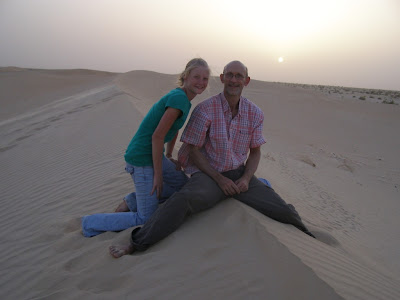
Suz and I on a dune in the Sahara

Embedded in the text of this blog are pictures of Timbuktu. Remember that the French spelling for the city is Tombouctou.

One final advantage of visiting the city is that now I can tell my friends I’ve been to Timbuktu.
Welcome to Timbuktu


Correction

I need to make a correction to my last post on THE BRIDGE. I said I didn't know of any other bridges between Niamey and Bamako, Mali over the Niger River. There is a new one that crosses the river at Gao, Mali, about 300 miles upstream from Niamey. Gao was the capital of the anicent Songhai empire, and we have concentrated our efforts in Niger on working with the Songhai people.

There is also another bridge that crosses part of the river to an island on which is a city, and that is upstream from Gao and past the bend of the Niger River.

Just thought I'd better clarify that. I don't think there are any other bridges over that stretch of river.

28.6.08

The Bridge

I haven't been able to write in my blog for some time. Unreliable internet access, slow speed, other priorities, viruses, power outages (there's one that just started as I logged on to blogger), and lack of time have prevented me from posting. Now I hope I can do this one before I lose the Internet server or my computer dies.

Last night we had a sad occurrence. Our cat, Midnight, died. I did a blog on her on 12
Dec 07, so if you want to read more about her, go to that post. She had been our kids' faithful pet for almost 16 years. It was sad to see her go, and it broke one more tie that we had to our "home" in Tera.
That isn't what I wanted to write about, but so much has happened in the past few weeks. What I really wanted to write about is THE BRIDGE. I use that word with the definite article because it is one of the few bridges across the upper reaches of the Niger River. In fact the bridge across the Niger in Niamey is, to my knowledge, the only bridge across the Niger for over 1000 km between Niamey, the capital of Niger, and Bamako, the capital neighboring Mali. Between here and there, the river makes a huge inverted U-shaped bend the passes through the southern reaches of the Sahara Desert.


But let's introduce the bridge more foramlly. The bridge is called the Kennedy bridge. It was funded by the US during the Kennedy administration in the 60's. It is about 1 km (o.6 miles) long and connects the two halves of Niamey on either side of the Niger River. It is well built and has stood up well to the traffic and ravages of weather and time. Unfortunately, it was never designed to accomodate the volume of traffic it now must sustain every day. It is a narrow, two-lane bridge which carries lots of super-loaded trucks, heavy car traffic, donkey carts, a gazillion motorbikes, many pedestrians, and even camels loaded with huge mounds of grasses and bags of who knows what. IT looks quite peaceful in this photo.


The bridge can be quite pictuesque, especially at sunset when the blazing orb of heat and light sets over the right bank of the river (to the left in the picture at right). At night, the streetlights blaze a curving arc over the main channel of the river. Camels bouncing across the bridge can seem very exotic, but you get used to them after a while, and you hardly even notice them. There are also the humorous sights like the spooked cattle wandering all over the bridge or the people doing laundry in the river and laying the clothes out on the island in the middle of the bridge to dry.


But mostly the bridge seems like a necessary evil. As the only artery connecting the two parts of the city, it is often clogged up by massive traffic jams. All it takes is one broken donkey cart to cause a traffic jam. And if a truck breaks down or there is an accident, it's chaos. When the president or a government official goes by the access road on the left bank of the bridge (a common occurrence as it's one of the main roads to and from the presidential palace), the bridge can be locked up for 20 or 30 minutes. We joke a lot about people going to the bridge specifcally to break down, and it often seems that they position their broken vehicle in the most awkward position to obstruct the maximum amount of traffic. There's always an adventure crossing the bridge. The speed of vehicles apparoaching and crossing the bridge is horrendous, and you have to make split second decisions sometimes to avoid disaster. Rush hours always tend to make me nervous. And if that isn't enough, sometimes the students or civil servants like to block the bridge to make their point about their grievances. They have even burned tires or smashed and burned vehicles on the bridge. The only university in the countrty is located on the left bank of the river just at the end of the bridge, so it is nice and convenient for the students.


The problem for many ex-pats is that they have business on both sides of the bridge. Sahel Academy is on the right bank of the bridge; we live on the left bank. That means a dangerous , polluted, and crowded commute to get Suzanne to and from school each day. Also, the Bible School is on the right bank. Many of our colleagues live on the right bank, some of them on the Sahel and Bible school compounds. The SIM Office is on the left bank, near our home. The airport is also on the left bank. So is the American Embassy. And many ex-pats live in the more up-scale sections of town on the left bank. So, we have to cross the bridge almost daily.


Niger is now about to build a second bridge across the Niger in Niamey, about a mile downstream from the current bridge. It is desperately needed. This time it will be built and funded by the Chinese. There are many Chinese contractors in town doing a lot of building right now. Recently, they bought up so much cement (partly for the bridge) that there were spot shortages of the commodity and the price went way up. That made it difficult for us to find and pay for cement we needed for ongoing building projects in the country. Oh, well, at least we'll be getting a new bridge. I hope it gets up soon. The old bridge needs some relief, and it can't come a moment too soon.
Ah, the power is back on, and I can post this before I head back home (I'm working at the office. We have no Internet access at home).

12.5.08

What is Success?

I've been thinking a lot about success and failure in the past few months. What constitutes success? Is it making a lot of money or having lots of friends and acquaintances? Is it having great status (fame) or power? Is it found in your job and what you do? Is it measured by your ability to create solutions to very difficult problems? Does it come by helping to alleviate suffering for thousands of people or by how big your house is?

In the Christian world we have our own means of defining success. Often we measure the number of decisions for Christ or the number of churches started. We look at how fast and how much a church grows over a period of five or ten years. We count the number of children saved from malnutrition and starvation. We look at how many people have gone on a missions trip in the past year. Are these accurate measures of "success"? I don't want to underestimate the value of numbers and statistics, but it seems to me that these are only superficial ingredients in our measurements.

What then is success? Is it simply remaining faithful to God and His calling? We've stuck it our for 16 years in a very hard place. And the result has been....what? Failure? If you look at the situation based on numbers of people coming to Christ or growth of the church, it sure looks like failure. Several people have written to tell us how they admired our grit and determination in the face of "impossible" odds. I don't know that I'm worthy of such praise. I certainly haven't done everything I could or should have done. And I've made plenty of mistakes. And except for Mike we haven't been able to recruit anyone to join us in the ministy. Is this failure? Or is it a success merely because we've been faithful and persevered for so long on our own with minimal help?

I'm not sure that even faithfulness by itself is an adequate measure of success. If you're faithful outwardly, but your attitude stinks, is that success? That was the case of the older brother in the parable of the prodigal son. I think there are several factors that constitute success.

Winston Churchill once said that "success is going from failure to failure without loss of enthusiasm." That's quite a statement. If you look at many of the world's greatest people, you see failure over and over in their lives. Both Churchill and Lincoln had periods of great failure. The apostle Peter also failed miserably. What distinguishes these men from other people is that they were able to pick themselves up, dust themselves off, and kept on going. Am I like that? Can I get up from this "failure" and continue to be faithful to God, to the church, to my family. I want to be like that. I don't want to give up because of failure. Perhaps that is the key to success. Even if the failure seems unfair or unhappy, I will keep going. I will put one foot in front of the other and continue to take the next step as God leads. I want failure to make me grow, not make me quit.

I want to be a success.

22.4.08

How do you say goodbye?

I haven't posted on my blog for a while. We've been in the process of moving, and it's been hard. Much harder than I expected. We moved into our new home in Niamey March 30 (see Nancy's blog for photos), but it took a while to get things organized and arranged, and I haven't done much work since March 15. Though we're fairly well settled now, we're still trying to set up a routine, and it's complicated by the extreme heat of the HOT SEASON in the West African Sahel. We're in the hottest time of the year, and it's hard to think after about an hour of work because your brain is so fried.

How would you say goodbye to a place where you have lived for 16 years? I lived in Tera longer than anywhere else in my life. Now I've had to say to goodbye. Here are my top ten ways to say goodbye. Hope this resonates with someone.

10. Learn from the mistakes of the past, but don't dwell on the past and its failures.
9. Don't ignore your feelings. Be honest and open.
8. Remember the good times you had.
7. Don't rush the process of resettlement.
6. Visit old haunts in your old location before you leave.
5. Let God show you the next step in His time.
4. Bring familiar things to your new home to keep up the continuity.
3. Take mementos of the place you're leaving with you.
2. Take lots of pictures to remember the old place.

And the number one way tosay goodbye:
1. Take time to grieve.

That's all for now. I hope to be able to post more often in the weeks to come.

23.2.08

Dam Bridges

Look--under the car. It's a dam. No, it's a bridge. No, it's a dam bridge. On the road to Tera there are five places in the last 50 km where the road crosses a bridge. But it isn't simply a bridge. As you can see in the photo, the water does pass under the road, but the road is constructed high above where the water flows. So the bridge also dams up the water and creates a small pond next to the road. Only in one of the dams does the water remain all year round. But in the other 4, the water lasts 4-6 months after the rainy season has ended. That means that the people in these villages have water in which to wash and water plants and animals for 7-9 months of the year. It helps to preserve surface water in a land that is short on this natural resource.


Since the construction of the paved road to Tera in 1997, we have bounced over these "dam bridges" (my affectionate term) many times. They signalled that we were getting near to Tera and home. When you come to the bridge, the road actually dips down onto the bridge. It's like the opposite of a speed bump. You wouldn't know it, but as you cross the bridge, there are actually conduits underneath which channel water under the road and over the dam. From the vehicle it looks more like a dam than a bridge. I didn't find pictures of one of the dams. I'll have to take one and put it on another blog.

31.1.08

JUBILEE!

Remember the law in the Old Testament (Levitcus 25) that mandated that every seventh year was to be a "sabbatical" in which no one was to sow or reap? The land was to lie fallow in remembrance that God is the true owner of the land, and the poeple needed to remember to honor Him. After seven cycles of this "sabbatical year" there was to follow another year called the year of Jubilee. In this year, all debts were to be forgiven, land was to be restored to its original owners, and no one was to sow or plant. The people were to remember that God is forgiving and merciful, and He delights to save those who honor Him.

This week I completed seven cycles of seven years and started my own "year of Jubliee." It is a year of liberation and freeing for me. For years the work in Tera has been a growing weight on my shoulders. In the past few weeks, God has lifted that burden and told me the time has come to move on. He will take the burden and bear it. Maybe the land in Tera needs to lie fallow for a while. We've sown many seeds there, often with sweat, toil, and tears. Now it's time to stop planting and let God work.

It's also a year of rejoicing as I look back on the past 49 years and see what God has done. It hasn't always been easy. I've chosen a road "less traveled" and that has definitely made "all the difference," to quote Robert Frost's famous poem. But there are wonderful memories and lots of laughter amidst the pain and the tears.

But the laborers are too few. There are a few believers in Tera now, but they are not strong and have tentative and marginally trained leaders. Is there anyone out there ready to come in and water the seeds? I long to see the day when the fields will be white to harvest. Actually, that's what the Songhai say when the millet is ripening, that the fields are turning "white." When the stalks dry up and become a drab whitish-brown, they are ready to harvest. May this day come soon for the Songhai. But God has his time, and it will come. Come quickly, Lord Jesus.

In the meantime, we rejoice and proclaim freedom for the captives, the restoring of sight to the blind, the loosing of the chains of those in bondage, and the ability to walk to the lame. This is the year of jubilee. May His mercy and forgiveness be known in all the earth.

16.1.08

Waiting

We've been in a waiting mode the past few weeks. As many of you know, our world has been turned topsy-turvy by a decision we made in December to move to Niamey because of Suzanne's health and personal needs. The official moving day was this past Monday, January 14.

We're waiting on God to show us the next step. What will we do in Niamey? What is God's plan for us? After 16 years of work in one place, we've been abruptly uprooted and moved to another. While I never doubted that the move to Niamey is the right one, I've been torn by the decision. I've not really wanted to do it and didn't think it was good for me. I asked the Lord for confirmation, and He responded more than once, assuring me this was for the best.

The first confirmation came during our annual field conference held Jan 5-9. Our speaker came from California, and almost everything he said spoke to my aching heart. One picture he painted was of a big building on Fifith Avenue in New York City. When you walk into the lobby, there is a statue of Atlas straining to hold up the world. Walk across the street to St. Patrick's Cathedral, and there you see a small statue of the baby Jesus holding the world in His hands. For a long time, I've felt the burden of the Songhai people on my shoulders. In one way the burden has been ours to bear because there are so few workes amongst the Songhai. In another sense, I've tried to bear a lot of the burden that belongs to God. During conference, that burden lifted, and I placed it back in God's capable hands. For the first time in years, I felt free of that heavy weight.

The second confirmation also came during conference when one of our African colleagues encouraged us by saying that he felt it was time for us to move but that our time in Tera had not been wasted effort in spit of the meager results we had seen. This man knows what he is talking about because he was born and raised in Tera. He currently teaches at Sahel Academy and has taught French to both of our children. He is a believer, but his extended family is not. He said that everyone in Tera knows about Christianity because of us and has some respect for what a Christian is. Even his own family allows him to stay "Christian" as long as it is like what Yaaye (my African name) and his family practice. That is a major step forward, and he says our being in Tera has encouraged him to persevere in his Christian faith. I don't have to tell you that I had tears in my eyes when he told me this.

A third confirmation came the day after conference ended. Nancy handed me the devotional book My Utmost for His Highest and pointed me to the entry for Jan 11. It struck me how it fit our situation so well. Listen to these words: "If we obey God, it will mean that other people's plans will be upset....We have simply to obey and to leave all the consequences with Him." Our friends in Tera did not react very well to the announcement that we would be moving away. They wanted to prevent that or at least mitigate the circumstances of our departure. For some of them, it will mean the loss of a job. Others will not have the teaching and spiritual input into their lives. For others, we've become like family to them. It is very hard to say goodbye. But what Oswald Chambers says applies to our situation very well.

A final confirmation came on Sunday, Jan 13, when our guard, a man who once seemed to have a strong faith but has fallen back some in the past three years, came to our house and said he and the others needed to get back together for meetings and studying. I was encouraged by that crack in the wall. He also commented that I seemed more at peace than I'd been in months, perhaps years. It showed me that this move seems to be the right thing, and I've decided in my mine that it is the right thing to do.

So, how am I going to wait? Our speaker at conference gave three suggestions:
1. Wait on the Lord, not for an answer to my questions. By the way, wait in Hebrew means trust.
2. Wait in a crowd. We'll be waiting with our SIM colleagues and our African brothers and sisters. It's not good to wait alone, as that is when Satan attacks.
3. While waiting, we will do what we can, even when it seems insignificant. God takes small acts of obedience and turns them into great things. The greatest things may be accomplished while we're in a waiting mode.

So, here in Niameywe wait. We are living temporarily in one house for 2 months until another house can be fixed up for us. We are learning to live without plans and by His timetable. We will step forward, and He will give us His power along the way.

12.12.07

Midnight

Midnight


No, I’m not talking about a time of day. I’m talking about our cat. Midnight has been our pet for over 15 years, almost the entire time we’ve lived in Téra. While we’ve had other cats, Midnight is the only one that has survived all this time, including three home assignments, when we were gone over a year each time.


We got Midnight about three months after we moved to Téra in 1992. Nancy had taken the kids and gone to see some women as she studied the Songhai language. While visiting at one home, the kids noticed a cat with kittens. Daniel pleaded with mommy for one of the kittens, and the rest is history.


Midnight is quite an attraction in Téra. She is older than half of the people in this country. Every so often, children come into the yard, and one will say to the other with some awe, “That cat is older than you are!” Also, Midnight is the only cat in Téra we know that has been fixed. After having three litters (we once watched some being born), we decided to have her spayed. This was the source of endless curiosity among the Songhai people. They came to see “the cat who had the operation,” laughing at the crazy white people who do such weird things.

Midnight has never been a terribly affectionate cat. She would almost never sit in anyone’s lap or purr. She is quick to hiss at you if you invade her private space. Her idea of affection is to jump up on the couch next to you and fall asleep right there. Daniel was the only one who could pet her and get her to purr.

Midnight once fell down the latrine. We were getting ready to go to Niamey and couldn’t find her, but we heard plaintive cries coming from the direction of that foul hole in the ground. With a flashlight we could see her down at the bottom looking up at her would-be saviors. We solved the problem of getting her out by putting a long log down into the latrine, and she climbed up it. Last year as we were getting ready to go to Niamey for our annual field conference, Midnight was very sick. We thought she was going to die, so we tearfully bade our good-byes to her. When we got back two weeks later, there was Midnight welcoming us, alive as could be. We were all very happy to see her.


Midnight is now an old lady. She has only one tooth left and isn’t quite as active as she used to be, but she still catches mice, and her vision is impeccable. She sneezes a lot and can't tolerate milk. She is much more affectionate that she used to be and she loves to curl up on the couch next to one of us, especially in the cooler weather at this time of the year. She even purrs. She has been a special pet for our kids, and when the time comes, it will be hard to say good-bye to her.


16.11.07

Walliyya aka Abdim's Stork

Walliyya

A bird commonly seen in W. Africa is the Abdim’s Stork, also known by its Songhai name, walliyya. This bird summers north of the equator and “winters” in southern Africa. I use the parentheses around “winters” because though it is “winter” in W. Africa, it is summer in southern Africa when the stork lives there, so you might say it’s a real “snow bird,” if that expression can be applied to Africa. It likes to be where there is eternal summer.

The Abdim’s stork usually appears in W. Africa in April and migrates back to southern Africa in October. This corresponds roughly to the hot, humid period in our part of the world. In April one of the common questions you may hear will be, “Have you seen a walliyya yet? The walliya is supposed to be a harbinger of the coming rainy season (June-September in Niger), and when you see one, you know that the rains are on their way.

Interestingly, the Abdim’s stork nests only when it is north of the equator. It is very gregarious and usually builds a nest in a tall, leafy tree in a town or a village near a water source. The brood consists of 2-4 eggs. During the rainy season, the chicks hatch and learn to fly, and by September, they’re ready for the long trek to southern African with their parents.

So it was quite a surprise one day this month (November, 2007) to see a walliyya walking around in the street outside out gate. They should all have been long gone by now. And this one wasn’t flying. Either it was injured in some way or it hatched late and was too young to fly when the migration took place. Earlier this week, the walliyya came into our yard looking for food, and we snapped these pictures of it.


It’s not the prettiest bird. Actually, it’s rather gangly and ugly, but it does play an important role in encouraging everyone during the long W. African hot season (March-June). You might call it the “rain bird.”

18.10.07

Choking Weeds


Isn't this a pretty picture? Some beautiful flowers floating on the edge of the Niger River at the ferry crossing. Actually these are dangerous weeds. They're called water hyacinths, and they're choking up rivers and lakes all over Africa, killing fish and the organisms they feed on. It's kind of like kudzu in the southern U.S. In some places, there is a mat of hyacinths several miles long extending from the shore out onto the surface of a lake. The fishermen have to struggle to paddle their boats to get to open water where the fish live. The mat of weeds gets bigger and bigger, and the amount of open water shrinks. It is difficult to get rid of this weed. Poisons don't kill it, and it harms the fish and the people who drink the water and eat the fish. It has no natural enemies that eat it, either. Recently, I read about a microorganism that feeds on the hyacinth. It gradually eats away at the roots little by little, killing one plant at a time. It was the only known method of getting rid of the flower at the time the article was written.


It occurred to me that maybe my life is a bit clogged up with clutter that is choking up my life. It's not so much sin (although every one of us has his or her besetting sins). It's just that I've got so many little details to manage that I can hardly think any more. My life is terribly complicated and full of lots of irreconcileable differences. I'm being pulled into Niamey for different meetings when my main ministry is supposed to be in Tera. I'm supposed to be working in the Songhai language with Songhai people, but I'm actually working mainly with other people groups using the Songhai and French languages. I have some priorities I want to work on this term in Niger: finishing up translation work and publishing it, launching the church in Doumba to be on its own, setting up a good language and culture learning program for Niger, and trying to get repairs to the sports field in Tera moving. But I have gifts that are barely getting used, and I'm getting a little frustrated by that. I'm wearing a lot of hats, and I'm being pulled in many directions. It's hard to concentrate on all these things and do them well. Then there's all the interruptions from people at my door. People are more important, but I also have to get some work done.

I need to simplify, but how? I can't set loose a lot of bugs to finish all the work. And I can't wave a wand and magically get everything accomplished. Little by little some things are moving forward, but it seems as slow as the desert tortoise. Maybe I need to stop and admire the "roses" God has created for a moment, even if they are destructive. These water hyacinths are prominent every year at this time on the Niger River. So far they haven't choked up the river, but they are sometimes a problem for the canoes. I don't want my life so choked up that I'm paralyzed. But I do want to have time for beauty and laughter. Let's look at the "roses."

3.10.07

The Road to Tera

Traveling the road to Tera is always an adventure. You never know what you're going to see or what is going to happen. This is true at no time more than the rainy season, which corresponds roughly to summer in the northern hemisphere. I have already posted a blog on the back road. Now it's time to talk about the main, paved road.
Shortly after Suzanne and I returen to Niger on July 30 after our summer vacation, we tried to return to Tera. At first, we heard that the back road had been washed out by heavy rains. At the same time the ferry wasn't working, so the main road was also not an option. We had to stay in Niamey a few more days than planned.
Finally, on Monday, August 6, we heard the ferry was working, and we could get to Tera. However, we were not informed of another hazard, and just a few miles outside of Niamey, we came upon this scene:


Now what should we do? It was already after noon. There was no way to get to the other side of the canyon. There didn't appear to be any detour around. Would we be able to get to Tera at all? This is what I mean by adventure.
We learned later that the bridge had been washed out by a wall of water that came down the creek on Saturday night, August 4. Over four inches of rain had fallen that night, and it was too much for the bridge. Probably the water washed away the road at either end of the bridge, causing it to collapse. Normally there is no more than a trickle of water flowing in this creek. I've never seen angry floodwaters in it.
At the time of the bridge collapse, a bus or taxi loaded with people was barreling down the hill from the other side. It dive-bombed into the canyone which had just been created and twenty people were killed. We heard by the grape vine that eight people were washed downstream and that their bodies were never recovered. Whether that's true or not, we don't know. In any case, all this happened the same week as the major bridge collapse in Minneapolis. Though this bridge was much shorter and only one vehicle was involved in the accident (in contrast to the many scary stories we've heard about the bridge in MN), this one produced more deaths.
Suzanne and I did find a way around the bridge (at that point it was a scary detour of about 5 miles which included lots of sand and mud) and we made it to Tera where we were able to stay for a week. The way around has now become a permanent detour (it has been graded and new dirt has been laid on it), and there is little risk of major floods now because the rainy season is over. We won't see much rain between now and next May.

In September, when Nancy came home, we took a lot of pictures of the broken bridge and the canyon created when it collapsed. Here are a few of my favorites.


The jagged edge of the road and the old bridge lying at the bottom of the canyon.


Me standing on the old bridge at the bottom of the canyon.


Nancy at the brink!

4.9.07

Multilingual

Any of you who know me know I like languages. I have studied six (including Biblical Greek and Hebrew) and speak three fluently(French, English, and Songhai) and know another African language a bit (Hausa). I get bored and restless in a monolingual environment. A multicultural, multilingual setting seems so much more dynamic and interesting. In the places I've lived in the US, I've unfortunately experienced more of the former than the latter. That is changing, however, and I think it is good for us as Americans, even though it does produce some "growing pains."

Thus it was fascinating last Friday, Aug 31, to participate in our monthly Day of Prayer meetings held in Niamey at Sahel Academy. Not only were we using French and English, the two main languages spoken by SIM people in Niger, but there were also other languages spoken. Two short-term workers from Romania gave their testimonies. One spoke in Swiss German (low German) and was translated into French. He is very gifted in languages and already knows some French and English in addition to German and Romanian. The other spoke in Romanian and was translated likewise into French. By the way, watch out for the Romanians. They are serious about their commitment to God and His work. They may become the next Koreans or Brazilians or Nigerians in the missions movement. Later in the prayer session we watched a DVD in Arabic with French subtitles. So, there were five different languages used in one prayer meeting! How's that for a taste of heaven?

I love being in this kind of work where many languages are used. Let's get used to multilingual environments. They're going to become more and more commonplace.

14.8.07

Good-byes

No one likes to say good-bye, especially if it's for a long time or potentially for a lifetime. I don't like good-byes, either, and I've had to say a lot of good-byes over the last few months.


The first good-bye occurred in June when we said farewell to our long-time colleagues Martin and Lucie Brown. They have been in Niger almost as long as Nancy and I, and their daughter, Naomi, has been one of Suzane's best friends. We don't if or when we will see them again.


The next good-bye was even harder. On Thrusday, July 26, I said good-bye to Daniel. I took him to breakfast that morning, told him everything I thought he needed to know (how do you do that in 30 minutes?), hugged him, and waved good-bye as he left for work. The tears misted my eyes as I drove back to MRF, where we had been spending our vacation. Later that day, Suzanne and I left PA to go to CT and fly on to Niger on July. It's hard to leave your grown-up son (who still seems so young) and not know if you'll see him in the next two years.


On July 27, I said good-bye to Nancy for five weeks. Though I'll see her again when she returns to Niger on Sept 5, I feel a little like a part of me is missing.


The last good-bye occurred when we arrived back in Niger on July 30. Unbeknownst to us, while we were en route, our dear friend and colleague, Helene Zoolkoski, died. She had been diagnosed 16 months ago with stage 4 melanoma. There is no cure for this stage of cancer. Helene did not take any medicine and remained symptom-free for almost a year. Her husband, Chris, is a doctor, and together they decided to return to Niger to live as long as they could here. Early this year, Helen began experiencing symptoms of the encroaching disease. I saw her for the last time in late April, and at that point she was having more good days than bad days, but by June when we left it was evident she was failing fast. The last week of July,while we were still in the US, we were hearing ominous reports of her condition, and we knew the end was near. In addition to her husband, she leaves behind three children: Elisheva, Zeb, and Joel. Eli was in the dorm last year and knows Suzanne well. She is the oldest at about 14. Joel is 6, and Zeb is about 10. They are returning to the US with their father tonight, August 14. Pray for them in the months ahead.


Nancy and I have known Helene since we were kids. She was only a year older than us, and we went to school together in Nigeria when we were all MKs. In our adult lives, we have worked with Helene in Niger off and on over the years. Nancy and Helene even taught together one year at Sahel Academy. She has been an educator, a mom, a wife, and a person of faith, and she will be greately missed and mourned in SIM Niger. Because of her love for and service to Sahel Academy, a tree was planted in her honor and in her memory at the school during this morning's opening assembly at the school. Good-bye, Helene

18.7.07

I was present at Creation

No, not the one that happened "in the beginning," but during our vacation in the US this summer, I have attended two events that had some relation to the word "creation."

The first event was Creation Festival 2007, a musical event in honor of our Creator. This was a camp with concerts by Christian artists which lasted for four days at the end of June. Suzanne, Nancy, and I went. There weren't many facilities at the camp (we had to walk a mile to get a shower and there wasn't running water or electricity hookups), but hey, we deal with a lack of amenities in Niger, so it wasn't much of a hardship for us. We got to hear some of my favorite artisits: Newsboys, Casting Crowns, David Crowder Band, Aaron Schuste, and Third Day. There were four different bands every night. We heard some new ones we had never heard of before. Leeland became a new favorite.

The Word of God also played an important part in the festival. There were messages by renowned speakers, and all the concession stands and booths closed down during the preaching. We had a lot of fun in the out-of-doors with the green and the fresh, cool air. We borrowed a tent and cooking utensils from one friend and sleeping bags from another.


It rained a few times, but we like rain. One night they said there were about 70,000 people at the concert!!!

Another day Daniel and I had the chance to go to Strasburg, PA to Sight and Sound theater to view the production of "In the Beginning." It was an elaborate stage recreation of the creation of the world, the fall, and, at the end, the restoration of the world to the way it was "in the beginning." The music and the production were excellent.

That's some of what we've done on vacation. No, the theme of our vacation is not "creation," but in some ways we are experiencing a recreation as we begin to feel refreshed and rejuvinated after a stressful and difficult year in Niger. We are also experiencing the wonders of God's creation as we hide out in the beautiful rolling Poconos of Pennsylvania.

8.7.07

50 YEARS

Humanly speaking, 50 years is a long time. How many of you can remember where you were 50 years ago? I can't because I haven't reached that milestone yet. That was 1957, and I wasn't born until two years later. Think of all the things that have happened in the last 50 years: econmical jet travel, missions to the moon, computers, e-mail, IM, independence for most African countries, many wars, the growth of evangelicalism, the Lausanne Covenenant, Islamic resurgence, people pushing for all kinds of "rights".
From God's perspective, of course, amd even considering the recorded history of the world, 50 years is a mere cursor blip on the screen. Casting Crowns sings a song that inculdes the following words:
"I am a flower quickly fading
Here today and gone tomorrow
A wave tossed in the ocean
A vapor in the wind..."
The song goes on to say,
"...Still you hear me when I'm calling
Lord, you catch me when I'm falling
You show me who I am:
I am yours...."
Isn't it great to know that we are His? That we belong to Him and that He controls all the years of our lives?
Fifty years ago an event happened that has great significance for my life even though I wasn't there when it happened: my parents got married. If it wasn't for that event, I wouldn't be here!! The date was 15 June 1957. To celebrate this great milestone, family and friends from near and far came together at Trinity Covenant Church in Manchester, CT, on 24 June 2007. We had a grand celebration remembering 50 years of God's faithfulness. I am the oldest of four boys, all of whom are in the picture below.
Nancy, myself, and our two children, Daniel and Suzanne, traveled from Africa to be there for the big day. Jim and Beth Anne and their boys along with two girlfriends came from New Jersey. Tim, Laurie, and boys, who livein Manchester, were all there. And Dave (the one who looks like me) flew in from Oklahoma. His wife Debbie and their four were unable to come, and we missed them. In addition, my mom's four sisters and their living husbands (one died of cancer two years ago) all came from Seattle, Washington. See the picture of my mom and dad (on the extreme right) and the sisters with their husbands on the left. The woman to the left of my mom is Aunt Muriel. Her husband, Uncle Sev, is the one who died.


My dad's brother came from Florida with his daughter (my cousin) and her husband. There were other guests, mostly members of Trinity Covenant Church, where my parents have attended for 30 years and where my dad has been pastor of missions and mentoring for many years. Others came from CT and from Florida.

The relatives arrived on various days of the week before the big day. We arrived from Africa on Monday, June 18. Those from Washington came in to Hartford on Thursday, June 21. The relatives from Florida were there on Saturday, June 23. And my brother from Oklahoma also came in on Saturday. We had a picnic at Tim and Laurie's on Friday, June 22. Unfortunately, it was cold and rainy. Saturday noon all the relatives that had arrived went to a Chinese buffet. And all the older generation went to a nice restaurant Saturday evening. That did not include anyone under 50.
Sunday afternoon, 24 June, on a glorious sunny day, we four boys hosted a reception for my parents at Trinity Covenant Church. We estimated about 200 people showed up. That was an excellent turnout to honor two who have modeled fithfulness and godliness to us all. Many could not make it. A 45-minute program in the sanctuary was well-received. Mom and Dad surprised us by making a powerful 20-minute DVD which included pictures I had never or rarely ever seen of them and us when we were growing up.

Fifity years. In this crazy world, where commitment no longer means what it used to and where people trade spouses like they trade commodities, we are pleased to honor my parents, Bob and Jean DeValve, on their 50 years of married life. Congratulations!

4.7.07

Rain and Traveling to the US

It's 3:30 p.m. on July 4th, and it's raining. A thunderstorm! Just like Niger. Though it's cold (only in the 60's), I try never to complain when there's clouds and rain. We see so little of either in Niger that I've come to appreciate both very much, even when it feels like winter to me. iIve got on a t-shirt and a sweatshirt. Our last day in Tera it was 111 F in the shade with about 40% humidity, a heat index of nearly 140 F. Unfortunately, we haven't heard that Niger has had much rain yet, and that's not good. They should have had rains starting before the end of June.

We're back in the US for a vacation. Our trip here was another adventure. We were supposed to leave from Niamey at 2:45 a.m. on June 18 (local time). We dutifully went out to the airport at midnight after not getting any sleep since 6:30 a.m. the previous day, when we got up to have church and travel down to Niamey from Tera. We quickly got through baggage check-in with our loaded suitcases, then proceeded to passport control. That took a while, and then we had to get in a line for security. It wasn't long before we were in the single waiting lounge in the departure section of the airport. We waited and waited and waited..... Our plane didn't even arrive until 3:30 a.m, and we weren't in take-off position on the single runway until 4:30, nearly 24 hours after we had gotten up the day before.

The big surprise of the trip was that we had a scheduled layover in Ougadougou (try that mouthful on for size), the capital of Burkina Faso, only a 45 minute journey from Niamey. We thought we were on a direct flight to Casablanca, Morocco. The layover was supposed to be 45 minutes, but it turned out to be triple that. First they asked Nancy and Suzanne, another family we were traveling with, and several others to move from the back of the plane. Then they unscrewed some of the back seats and lowered them to install a frame for a stretcher. Then they installed the stretcher and a curtain and carried a sick patient onto the plane, escorted by his daughter and doctor. I had never been on a plane with a medivac before. It was quite dramatic. It was well after sunrise before we took off around 6:30, and we had burned up over three hours of a scheduled 3 hour, 40 minute layover in Casablanca. We were afraid we would miss our flight to New York, but when we landed in Casa at 9:40, we had hope we might make it to the 10:45 flight.

We had to go through security into a waiting lounge, and then we were bused to a secondary terminal, past our waiting plane sitting on the tarmac. At the new terminal, our plane was already boarding. We had to go through secondary security: a thorough check of our hand luggaged and a frisk down. I was wearing cargo trousers with a lot of pockets, and they were full of travel stuff. I dutifully pulled everything out of my trousers. One thing I was carryin in a side pocket was a bee-sting kit. I'm allergic to bee strings and have to carry this kit wherever I go. The policemen looked at it, promplty popped the 1/2-inch needle out of it and reprimanded me for trying to take a needle on the plane. I tried to explain that I'm allergic to bee stings, and the medicine in the kit could save my life. He glared at me, seeming not to comprehend a word I was saying (all in French) and not happy with the needle sticking out of it. I don't think he'd ever seen or heard of such a thing. He said he'd have to confiscate it. I said he might as well because he'd exposed the medicine to the air, and it would lose its potency quickly as a result. We got on a bus that took us halfway back to the other terminal, where our plane waited. We boarded our flight and took off only a half hour late (11:15 a.m. local time). We made up the time in the air, and arrived exactly on time at JFK in New York at 2:45 p.m. NY time. We breezed through passport control, baggage claim, and customs, and found ourselves out in the lobby of the international building arrivals area. We had decided to take the "Connecticut Limo," a fancy name for a comfortable van, to Hartford, CT to meet my parents. It was an expensive, but easy way to leave the New York driving to someone else. We were picked up at 4: 30 p.m., but it took another hour to pick up other riders at other terminals, and we had to switch vans at one point to accomodate even more passengers. So it was after 5:30 before we left the airport, and you know what that means on a Monday afternoon. It was bumper to bumper on the Van Wyck "Expressway" until we got to the bridges going over the East River to the mainland. Then we had to drop passengers off in three different places in CT before we got to Hartford. My brother, his son, and my mom were waiting there with a van to pick us up with our large assortment of baggage and take us home. We went home, had a delicious supper of subs, and then crashed at about 10:30 p.m., EDT, nearly 24 hours after we had taken off from Niamey, and about 45 hours since we had had any real sleep. This is the stuff of international travel, and I begin to wonder why I thought traveling was so much fun when I was younger.

Next blog I'll detail some of the things we've been doing on vacation.

8.6.07

Graduation

I'm tired and emotinally drained after a week of celebrating our son Daniel's graduation from high school (see picture below). Where have the years gone? It's only this week that it's beginning to hit me that Daniel will not be around next year with his playful spirit and sincere heart. I'm really going to miss him. He has grown up and is ready to fly on his own. It's true he's been in the dorm at Sahel Academy in Niamey for a number of years, but he was only a 3-hour drive (and this past year a quick phone call) away. Now, he'll be nearly a full 24-hour day journey away by plane, and the contact will be much more difficult. I know he can cope, but I still want to protect him from all the unknowns.
This week there were two big ceremonies to honor the 6 graduates of Sahel Academy (SA). (Daniel was the only American among the six--there were 2 Koreans, 2 Nigerians, and one Ghanaian, in addition to Daniel). The first was the graduation banquet Tuesday night, June 5. All the staff of SA, the juniors and seniors, and the families of the graduates were invited. It was a time to laugh and cry as we remebered the years that each of these 6 have spent at SA. Of the six seniors, Daniel had been at Sahel the longest, starting there in 1999, when he was in 5th grade. The juniors gave some prophecies about where each of the seniors would go and what they would do in life. Some of the prophecies were really funny and fit quite well the personalities and backgrounds of the seniors.

After the prophecies, each parent had a few moments to share some thoughts with their children. Nancy reminded everyone how Daniel loves food and exhorted him to feed on the Word and not just on bread alone. I recalled the time when Daniel was 3 and came up to Nancy and said to her, "Mommy, when I grow up, I want to be a killer." After being reprimanded for saying something so awful, Daniel, nearly in tears, had replied, "But I just wanted to be a killer like David who killed Goliath." I told Daniel that there are many giants out there, and they can be quite fearsome. But I reminded him that, like David, we do not need to fear, because God is with us and we are on His side. Then I said he had our blessing to be a killer and to go out and slay some giants.After all the parents had finished their speeches, I got up and sang a song sung by Mark Harris called, "Find Your Wings." I can't sing it like Mark Harris, but it expressed a lot of what I would like to say to Daniel and all the seniors at this time. I made it through the song without choking up. Here are the words:

Find Your Wings

It's only for a moment you are mine to hold
The plans that heaven has for you will all too soon unfold
So many different prayers I pray for all that you might do
But most of all I want to know you're walking in the truth

And if I've never told you
I want you to know,
That as I watch you grow

Chorus:
I pray that God would fill your heart with dreams
And that faith gives you the courage to dare to do great things
I'm here for you whatever this life brings
So, let my love give you roots,
And help you find your wings.

May passion be the wind that leads you through your days
And may conviction keep you strong,
Guide you on your way.
May there be many moments
That make your life so sweet
But more than memories

Chorus

Bridge:
It's not living, if you don't reach for the sky.
I'll have tears as you take off,
But I'll cheer as you fly.

Chorus

The graduation ceremony was last night, Thursday, June 7, at the Ministry of Foreign Affairs in Niamey. It was attended by everyone from the international community involved with SA, about 100 adults and children. In addition to a speech by one of the faculty and by the director of the school, each graduate gave a short speech. None of the six graduates like public speaking very much, but all six did an excellent job. Daniel did the best speech of his life, and I was so proud of him (we have it on video). He even spoke a few words in Songhai to his best friend from Tera whom we had invited down for the occasion. I couldn't help the tears during the ceremony. It was very moving. Afterwards, there was a simple reception in the SA dining hall, with cake punch, snacks, and most importantly, the love of friends and colleagues. And then it was all over, and Daniel is now flying on his own. The high school kids stayed up all night watching all three Lord of the Rings videos in the extended version. But Nancy and I came home to try to calm down and get some sleep. We were going to go back to Tera today, but we are too tired and have too much to do, so we'll go back tomorrow, where we'll spend a week letting Daniel say good-bye to his home and packing up for our trip to the US on June 18.

Congratulations, Daniel!!